

LOOSE DRIED HERBS · PACKED TO ORDER
Rose Hips are the fruit the rose leaves behind after its petals drop — deep red-orange, tart as a crab apple, cut and sifted so they give up their color fast. Generations gathered them in late autumn and leaned on them through the months when no fresh fruit was growing. They reward a simmer rather than a quick steep, and they demand a proper strainer.
Fruit, Not FlowerRose hips form after the petals fall. This is the fruit of the rose.
Tangy And RedSharp and fruity, and it turns the water a deep rosy orange.
Simmer, Do Not SoakDense fruit gives up far more in ten minutes of low simmer.
Strain It ProperlyFine hairs live around the seeds. A wide basket infuser is not enough.
What Are Rose Hips?
A rose hip is the fruit of the rose. Once the petals of Rosa canina, the wild dog rose, fall away, the base of the flower swells into a glossy red-orange pod holding seeds and fine hairs. Ours is that fruit, dried and cut and sifted, seed included. Rose hips have been simmered into syrups, jams, soups and teas across northern Europe for centuries, and were traditionally valued for their vitamin C in seasons when fresh fruit was scarce. Our dried rose hips are cut and sifted and steep into a tart, tangy, ruby-red tea.
Meet Our Dried Rose Hips
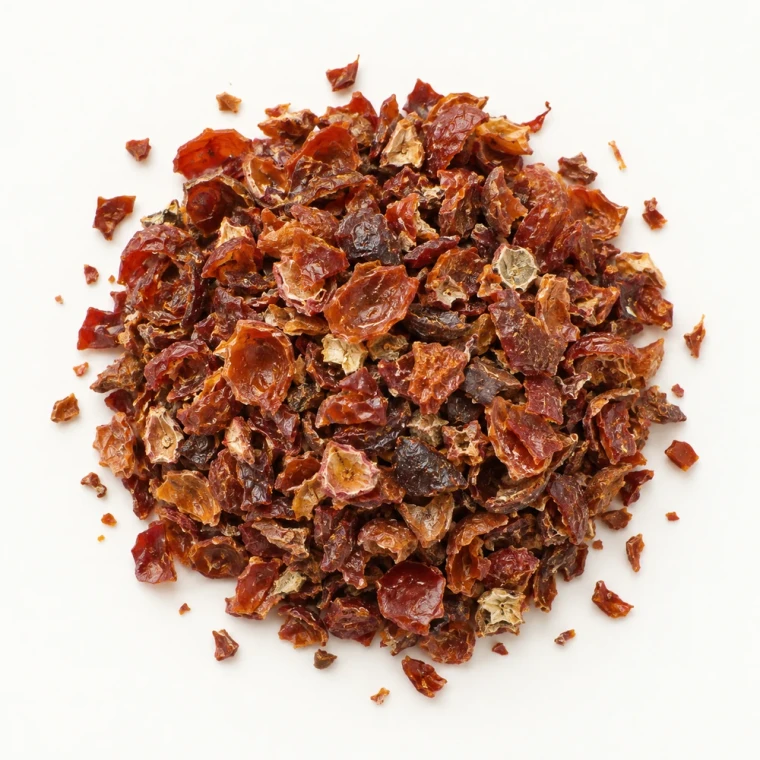
The cut runs brick red through rust orange, a mix of shell fragments and pale, hard seed pieces. Both belong there. A batch of nothing but red shell has been sieved so aggressively that much of the fruit went with it. Dry, ours smells faintly of stewed apple. Squeeze a piece and it feels firm and slightly gritty, nothing like a soft dried berry. In hot water the color moves within a minute.
Why Rose Hips Need Real Straining
Inside every hip, packed tightly around the seeds, sit thousands of stiff, needle-fine hairs. They are famous for it: generations of schoolchildren used them as itching powder, and the irritation is real if enough of them reach your throat. Cut and sifted hips have most of that material shaken out, but not all of it. Brew in a bag or a paper filter, or pour the finished cup through fine mesh lined with muslin. A basket infuser with wide slots lets the hairs straight through.
Tart, Fruity & Bright: Sharp and clean, something like sour apple skin with a little rosewater sitting behind it. The liquor comes out warm orange-pink and thickens slightly under a long simmer. Astringent at the edges, and generous if you help it along with honey.
Taste, Texture & Aroma
Properly brewed, rose hips taste tangy rather than sour, closer to a tart apple or an underripe plum than to lemon. A light astringency dries the mouth, and there is a faint floral note underneath if you look for it. The body is fuller than most herbal teas, because you are extracting fruit, not leaf. A spoon of honey turns the cup into something like a hot fruit cordial.
Blending Rose Hips With Other Herbs
Rose hips do two jobs in a blend: they bring acidity, and they bring color. That makes them the standard fix for a cup that tastes flat or looks muddy. They sit naturally with anything else fruity or floral and hold their own against even a strong mint.
- With Hibiscus Flowers — the classic. Hibiscus brings a deeper, wine-like tartness and a red so strong the pair needs no help at all.
- With Elderflower — elderflower's honeyed, muscat scent floats above the tartness. This is the late-winter blend: hot, with a spoon of honey.
- With Lemongrass — a citrus top note over fruit body. Brew it strong and ice it; unsweetened, it drinks like a proper fruit cordial.
- With Peppermint Leaf — sharp mint against tart fruit. It reads oddly on paper and excellently in the cup, and it stays good cold.
- With Nettle Leaf — nettle lays down a deep green, mineral base and rose hips make it drinkable. A traditional daily infusion pairing.
- With Calendula Flowers — mostly for looks, honestly. Gold petals against red shell make the prettiest mix we sell, and calendula stays out of the way.
Who Rose Hips Are Best For
Our Rose Hips are a good fit for:
- Winter tea drinkers who want something tart and warming with no caffeine in it.
- Home cooks — hips simmer down into syrups, jellies and Scandinavian fruit soups.
- Blenders who need acidity and color to rescue a cup that tastes flat.
- Iced tea makers — rose hips brew strong and stay bright in the refrigerator for days.
- Anyone who finds herbal tea boring. This one actually tastes of something.
How To Make Rose Hip Tea
Use one to two teaspoons per eight ounces. The best method is a decoction: put the hips in cold water, bring it to a bare simmer, hold it ten to fifteen minutes with the lid on, then strain. If you would rather steep, use boiling water, cover the cup, and give it a full fifteen minutes. Either way, strain through fine mesh or a paper filter, never a wide basket. Sweeten while it is hot.
Key Benefits & Everyday Uses: Rose Hips
Rose hips have a long and well-documented history in European kitchens and stillrooms. What follows is that tradition, how they have been used and why people kept climbing hedges to gather them. It is history, not a claim about outcomes.
- A traditional winter fruit — gathered after the first frost and kept for the months when nothing fresh was growing.
- Traditionally valued for vitamin C — this is the reason hips were collected and dried in the first place.
- Rose hip syrup — during the Second World War, British volunteers gathered wild hips by the ton for a national syrup scheme.
- Scandinavian fruit soup — nyponsoppa, made from simmered and sieved hips, is still an everyday dish in Sweden.
- A caffeine-free everyday cup — tart enough that most people drink it plain, morning or midnight.
- A natural colorant in blends — herbalists use hips to give pale mixes a warm red-orange body.
Rose Hips Details
- Botanical name: Rosa canina
- Plant part: Fruit (hip), with seed
- Cut: Cut & sifted
- Sizes: 0.5 oz and 1 oz
- Origin: Packed at our Virginia farm-based apothecary
- Contains: 100% rose hips. Nothing else.
Directions For Use
- Use 1 to 2 teaspoons per 8 oz of water.
- Best simmered: start in cold water, bring to a low simmer, hold 10 to 15 minutes covered.
- If steeping instead, use boiling water and give it a full 15 minutes.
- Strain through fine mesh, muslin or a paper filter. The fine seed hairs can irritate.
- Sweeten while hot. Rose hips take honey particularly well.
Storage & Freshness
Rose hips are a dried fruit, so they hold more residual moisture than leaf herbs and will clump if air reaches them. Keep them airtight, cool and out of the light. Check occasionally for softness or a sweet fermented smell, both of which mean moisture got in. Stored properly they hold color and tang for a year or more.
Safety Notes & Warnings
Rose hips are a food, and most people drink them without a second thought. The cautions worth knowing come down to the seed hairs and to a short list of medications and conditions.
- Strain thoroughly. The fine hairs around the seeds can irritate the mouth, throat and digestive tract if they get into the cup.
- Talk with your provider if you take blood-thinning medication. Rose hips are commonly flagged as worth checking first.
- If you are prone to kidney stones, or have been told to watch oxalates, ask before drinking them daily.
- People with an allergy to plants in the rose family should approach carefully. The hip is that family's fruit.
- A very strong brew can loosen the stomach. Back the amount off if that happens to you.
- Pregnant and nursing parents should check with a provider before daily medicinal-strength use.
Our Virginia Farm-Based Apothecary Approach
Serene Tree Apothecary is a small Virginia farm-based apothecary. We buy our botanicals in small lots, taste and smell every batch before it goes on the shelf, and pack to order so what arrives is fragrant rather than dusty. Nothing here is a filler blend, a flavoring, or a mystery powder — it is one plant, cut and sifted, exactly as it appears on the label.
What Makes Our Rose Hips Different?
We buy hips already cut and sifted, then look hard at two things: real color and a real mix. A batch that is uniformly dark has been sitting somewhere warm, and a batch with no seed at all has been over-sieved and lost half its flavor on the way. Ours runs brick through rust with plenty of shell in it. We pack to order, so what reaches you still smells of stewed apple rather than dust.
Why Choose Serene Tree Apothecary Rose Hips?
This is a small Virginia farm-based apothecary: one plant per order, weighed out when you buy it. Rose hips are cheap enough that people buy them carelessly, which is exactly why so many end up with pale, tired ones. Start with half an ounce and watch the color it throws in the first minute. If it does not run deep orange-red, you will know we did not do our job.
These statements have not been evaluated by the Food and Drug Administration. This product is not intended to diagnose, treat, cure, or prevent any disease. Herbs are traditional foods and botanicals, not medicine. If you are pregnant, nursing, taking prescription medication, or managing a health condition, talk with your healthcare provider before using any herb.
Rose Hips FAQ
Are rose hips the same as rose petals?
No. The petals are the flower; the hip is the fruit that swells at its base after the petals drop. They taste nothing alike, since petals are perfumed and delicate while hips are tart and fruity. Ours are hips from Rosa canina, the wild dog rose.
Why do rose hips need such careful straining?
Each hip holds fine, stiff hairs packed around the seeds. Children have used them as itching powder for generations, and they can irritate the mouth and throat if enough end up in your cup. Brew in a bag or paper filter, or strain through fine mesh.
Should I simmer or steep rose hips?
Simmer, if you can. Hips are dense fruit rather than thin leaf, so ten to fifteen minutes at a bare simmer pulls out far more color and flavor than a short soak. If you only steep, use boiling water, keep it covered, and give it a full fifteen minutes.
Do rose hips have vitamin C?
Rose hips have traditionally been valued for their vitamin C, which is precisely why they were gathered for winter across northern Europe. We make no nutrient claim about our product: drying, storage and brewing all affect what remains, and we do not test for it.
Why are there seeds mixed in?
Because that is what a cut and sifted hip is. Shell and seed are dried and cut together, so pale hard fragments among the red are perfectly normal. A batch of nothing but red shell has been over-sieved, and a good deal of the fruit left with the seed.
Do rose hips have caffeine?
None at all. Rose hips are fruit, unrelated to the tea or coffee plant, so a cup at ten at night is no different from one at breakfast. The tartness is what makes people assume otherwise, but that is acidity, not a stimulant.
Can I make syrup or jelly with these?
Yes, and it is the oldest use there is. Simmer the hips in water, strain very thoroughly through muslin, twice if you can, to catch the hairs, then sweeten and reduce. Rose hip syrup and Scandinavian rose hip soup both begin exactly that way.
What do rose hips taste like?
Tangy rather than sour: think tart apple skin or an underripe plum, with a light astringency and a faint floral note behind it. The body is fuller than most herbal teas, since you are brewing fruit. Honey suits them, though plenty of people drink them plain.