
VIRGINIA FARM-BASED APOTHECARY HERBS
Nettle Leaf does not sting. The formic acid and histamine that make a fresh nettle patch memorable live inside tiny hollow hairs on the leaf, and drying collapses them completely — you can run dried nettle through your fingers with no more risk than dried spinach. What is left is a deep green, savory, mineral-tasting leaf that herbalists have infused overnight for generations.
It Will Not StingDrying neutralizes the sting completely. Handle it like any other leaf.
Green And SavoryCloser to spinach broth than to tea. Some people salt it.
Long Steep Or NothingFour minutes gets you green water. Give it hours in a jar.
The Oat Straw PartnerEqual parts nettle and oat straw is the classic daily infusion.
What Is Nettle Leaf?
Stinging nettle (Urtica dioica) is a tall perennial that spreads by root across damp ground and field edges nearly everywhere in the temperate world. This is the leaf, cut and sifted, taken before the plant flowers. Nettle has been eaten as a spring green and drunk as an infusion across Europe for as long as there are records of either — cooked like spinach in the pot, steeped by the quart in the jar. It is one of the oldest food plants still in regular use. Steeped as nettle tea, the dried leaf gives a green, earthy, caffeine-free cup that many people drink daily.
Meet Our Nettle Leaf
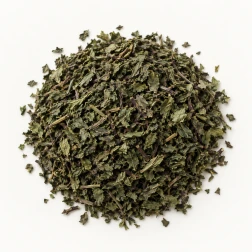
Color is the thing to look at with nettle. Ours is a genuine dark forest green, not khaki and not brown, because green fades toward brown with age and heat and there is no hiding it. The cut is medium — flat leaf pieces with their serrated edges still visible, and very little stem. Dry, it smells faintly of hay and seaweed. It smells far greener once hot water hits it.
Why Dried Nettle Cannot Sting
A fresh nettle stings because the leaf is covered in hollow silica hairs, each one a brittle little needle. Brush the plant and the tip snaps off, the hair goes into your skin, and a mix of formic acid, histamine and a few other irritants goes in with it. Drying destroys that entirely: the hairs collapse, the fluid is gone, and there is nothing left to inject. Cooking does the same, which is why nettle soup is safe to eat. Handle this bag with bare hands.
Deep, Green & Savory: Not really a tea flavor at all. Nettle reads savory — dark green, faintly salty, somewhere between spinach water and a thin vegetable broth, with a dry hay note behind it. Rich rather than refreshing.
Taste, Texture & Aroma
A short steep tastes thin and green. A long one is a different drink: dark, nearly black-green, with real weight to it and a distinctly savory, mineral finish. People either take to that immediately or need it blended. A pinch of salt in a strong nettle infusion is an old trick and it works, turning something that tastes half-finished into something closer to broth.
Blending Nettle Leaf With Other Herbs
Nettle is a base, not a flavor. It gives a blend body, color and a green foundation, and then it needs something on top — sweetness, citrus or mint — to make a whole quart of it easy to finish. Half nettle, half everything else is a sensible start.
- With Oat Straw — the pairing everything else is measured against. Oat straw's cereal sweetness cancels nettle's savory edge. Equal parts, a quart jar, eight hours.
- With Rose Hips — tartness is what a savory herb wants most. Rose hips also need a long steep, so they run on nettle's schedule without any fuss.
- With Peppermint Leaf — the fastest fix if you dislike the broth note. Mint sits on top of nettle rather than mixing into it, and covers it well.
- With Lemongrass — a smaller job than mint but a cleaner one. A pinch of lemongrass lifts the jar without hiding the green underneath it.
- With Marshmallow Leaf — softens the texture rather than the taste. Useful if long-steeped nettle feels a little rough across your tongue.
- With Tulsi (Holy Basil) — clove warmth over cold green. An unexpected pairing that makes nettle taste deliberate rather than merely worthy.
Who Nettle Leaf Is Best For
Our Nettle Leaf is a good fit for:
- People who make a quart jar infusion and drink it through the day rather than brewing single cups.
- Anyone building a green herb shelf — nettle and oat straw together are where most people start.
- Cooks who want a savory herb for broth and soup, not just another thing to steep.
- Spring drinkers — nettle has centuries of tradition as the first tonic herb of the year.
- People who garden and get stung every summer and want to know what the plant is actually for.
How To Use Nettle Leaf & Make Nettle Tea
Nettle needs volume and time. Put a generous handful, roughly a quarter to a half ounce, in a quart jar, fill it with boiling water, cap it and leave it four to eight hours or overnight. Strain well, then drink it cold, over ice, or gently rewarmed. For a single cup, use a heaping tablespoon per eight ounces and give it at least fifteen minutes covered. Refrigerate the rest and finish it within a day.
⚠️ Nettle leaf has a mild diuretic effect and may affect blood pressure and blood sugar. It also naturally contains vitamin K, which is exactly what warfarin and similar blood thinners are dosed against. If you take a blood thinner, a blood pressure drug, a diuretic or diabetes medication, talk with your prescriber before drinking nettle regularly.
Key Benefits & Everyday Uses: Nettle Leaf
These are traditional uses and nothing more. Nettle's reputation rests on a very long run as food and as a daily infusion across Europe and North America, not on anything we are claiming it will do for you.
- The classic spring tonic — traditionally the first green picked and drunk after winter, across most of northern Europe.
- A traditional nutritive infusion — herbalists have long treated a quart of nettle more like food than like tea.
- A savory kitchen green — dried nettle goes into soup, broth, risotto and bread dough as readily as into a jar.
- A traditional hair rinse — brewed strong, cooled completely and poured over hair after shampoo, an old household practice.
- An everyday caffeine-free drink — enough body to satisfy people who find most herbal tea watery.
- A blending base — herbalists reach for nettle to give thin, sharp or floral blends a green floor to stand on.
Nettle Leaf Details
- Botanical name: Urtica dioica
- Plant part: Leaf
- Cut: Cut & sifted
- Sizes: 0.5 oz and 1 oz
- Origin: Packed at our Virginia farm-based apothecary
- Contains: 100% nettle leaf. Nothing else.
Directions For Use
- Handle it with bare hands — dried nettle does not sting.
- For the traditional infusion, put a generous handful in a quart jar and fill it with boiling water.
- Cap it and leave it 4 to 8 hours, or overnight. Strain well.
- For a single cup, use 1 heaping tablespoon per 8 oz and steep 15 minutes covered.
- Refrigerate the strained infusion and finish it within about a day.
Storage & Freshness
Keep nettle sealed, dark and dry. Light is the enemy — a clear container on a sunny counter turns deep green into brown khaki within weeks, and the flavor goes the same way. A cupboard is fine; a windowsill is not. Well stored it holds color and character about a year. Judge it by color, not by date.
Safety Notes & Warnings
Nettle is a food plant, but it is also the herb on our shelf most likely to matter if you take prescription medication. Read this list properly rather than skimming it.
- Blood thinners. Nettle leaf naturally contains vitamin K, which warfarin and similar drugs are dosed against. Talk with your prescriber before drinking it regularly.
- Blood pressure and blood sugar. Nettle may affect both. If you are medicated for either, check first and keep an eye on your numbers.
- It is mildly diuretic. Expect more trips to the bathroom, and be careful if you already take a diuretic.
- Talk with your provider before drinking nettle during pregnancy or while nursing, whatever you may have read elsewhere.
- A quart of infusion is a great deal of liquid. Start at a cup a day and work up from there.
- Strained infusion spoils like any other brewed drink. Keep it refrigerated and do not leave it out overnight.
Our Virginia Farm-Based Apothecary Approach
Serene Tree Apothecary is a small Virginia farm-based apothecary. We buy our botanicals in small lots, taste and smell every batch before it goes on the shelf, and pack to order so what arrives is fragrant rather than dusty. Nothing here is a filler blend, a flavoring, or a mystery powder — it is one plant, cut and sifted, exactly as it appears on the label.
What Makes Our Nettle Leaf Different?
Nettle is sold by weight, and weight is easy to make up with stem. A lot of what is on the market is stalk and leaf stalk with leaf mixed through, which brews thin and tastes woody. We buy on color and leaf content: deep green, mostly leaf, sifted so the coarse stem does not come along for the ride. Small lots, packed to order, so what you open is still green rather than brown.
Why Choose Serene Tree Apothecary Nettle Leaf?
If you drink nettle the traditional way, by the jar, you will move through an ounce quickly — so the ounce is the sensible size, and the half ounce is for finding out whether the savory side suits you at all. We are a small Virginia farm-based apothecary. We pack to order, we sift the stem out, and we put one plant in the bag. If it arrives brown, we want to hear about it.
These statements have not been evaluated by the Food and Drug Administration. This product is not intended to diagnose, treat, cure, or prevent any disease. Herbs are traditional foods and botanicals, not medicine. If you are pregnant, nursing, taking prescription medication, or managing a health condition, talk with your healthcare provider before using any herb.
Nettle Leaf FAQ
Does dried nettle still sting?
No. The sting comes from hollow hairs that inject formic acid and histamine when they break against skin, and drying collapses them and dries out the fluid inside. There is nothing left to sting with. You can pour it, measure it and handle it with bare hands.
What does nettle tea taste like?
Savory rather than sweet. Think spinach water or a thin vegetable broth, deep green and slightly salty, with a dry hay note underneath. Steeped a long time it gains real body. It is closer to a light soup than to what most people picture when they hear herbal tea.
How long do I steep nettle leaf?
Longer than you think. Fifteen minutes covered is the minimum for a cup, and the traditional method is a quart jar left four to eight hours or overnight. A four-minute steep gets you pale green water and very little of what people drink nettle for.
What is the difference between nettle leaf and nettle root?
They are different products from the same plant and are not interchangeable. This is the leaf, traditionally used as a long-steeped daily infusion and as a cooking green. The root has an entirely separate history of traditional use and is usually sold and prepared on its own.
Can I cook with dried nettle leaf?
Yes, and it is genuinely good that way. Stir it into soup, broth or risotto in the last ten minutes, or work it into bread dough. It behaves like a dried leafy green rather than a seasoning, so use a generous hand and expect real color from it.
Can I drink nettle every day?
It has traditionally been taken that way, as a daily infusion over weeks. Start with a cup a day rather than a quart. If you take blood thinners, blood pressure or diabetes medication, or a diuretic, talk with your prescriber first — that caution matters more than the schedule.
Why is some dried nettle brown instead of green?
Age, light or too much heat in drying. Nettle should be deep forest green, and it loses that first. Brown or khaki leaf will still make tea, but it brews thin and tastes more like hay than like the plant. Color is the fastest quality check you have.
What can I mix with nettle if I dislike the taste?
Peppermint Leaf is the quickest fix and covers the broth note well. Oat Straw sweetens it without masking it, Rose Hips add tartness on the same long schedule, and a pinch of Lemongrass lifts the whole jar. Start at half nettle, half everything else.