

VIRGINIA FARM-BASED APOTHECARY FLOWERS
Calendula Flowers is pot marigold — Calendula officinalis, the orange garden flower that has been dried for skin oils and gentle tea for at least five hundred years. It is not the pungent Tagetes marigold from the bedding-plant rack; that one is a different genus entirely. Ours is cut and sifted, so you get petals plus the resinous green base.
Also Called MarigoldPot marigold — not the Tagetes bedding marigold from the garden center.
Cup Or SkinMild enough to drink, resinous enough for an infused oil.
Whole-Flower CutPetals plus the sticky green calyx, where most of the resin sits.
Colors EverythingGives broth, rice and oil a warm gold — hence poor man's saffron.
What Are Calendula Flowers?
Calendula is an easygoing annual daisy with bright orange and yellow flower heads that bloom until frost. Cooks knew it as pot marigold because the petals went into the soup pot; herbalists dried the whole head for skin oils, washes and salves. It has been a fixture in European kitchen gardens since the medieval period. The name comes from calendae, a nod to how nearly year-round it flowers. Our dried calendula flowers are cut and sifted from whole blossoms, ready for infused oils, salves and a mild golden tea.
Meet Our Dried Calendula Flowers
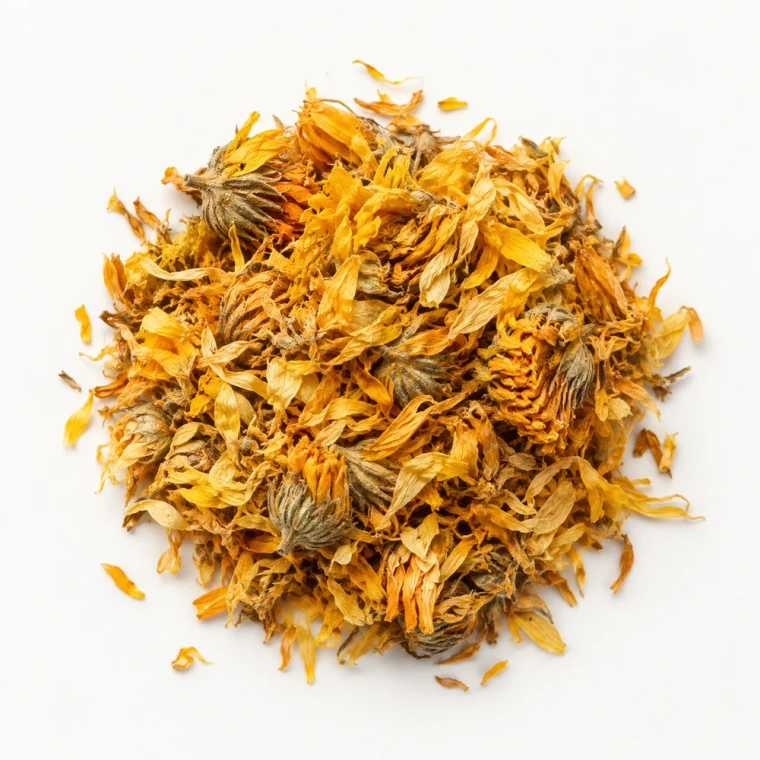
Open the pack and it is mostly petal: ribbon-shaped rays in orange, apricot and deep gold, mixed with pieces of the green calyx cup and a few whole small heads. The petals feel dry but slightly tacky, which is the resin. The smell is honeyed and grassy with a faint bitter note behind it, and it colors your fingertips if you handle a lot.
The Sticky Green Base Matters
Petal-only calendula looks prettier, but the resin — the sticky part herbalists want for oils and salves — is concentrated in the green calyx at the base of the head, not in the rays. That is why whole-flower and cut-and-sifted material makes a better infused oil than a bag of loose petals. The color story is different again: calendula's pigments are carotenoids, which are fat-soluble, so oil takes on far more gold than water ever will.
Honeyed, Grassy & Faintly Bitter: Soft and hay-sweet up front, with a resinous bitterness underneath that shows up if you steep it long. Think warm meadow rather than perfume. The liquor is a clear amber-gold that deepens the longer the petals sit.
Taste, Texture & Aroma
Mild, but not bland. The first sip is honey and dry grass, then a clean bitter edge arrives at the back — closer to dandelion greens than to anything sharp. Texture is light and clean with no astringency. Left in the water past ten minutes the bitterness takes over, so most people pull the petals early and let color do the rest of the work.
Blending Calendula Flowers With Other Herbs
Calendula is a team player twice over: it blends in the cup, and it blends in the oil pot. In tea it lends color and a soft honeyed base without shouting. In oil it is the flower nearly every salve recipe starts with.
- With Marshmallow Leaf — marshmallow brings a slippery softness, calendula brings color and a honeyed base. A very gentle everyday cup.
- With Rose Hips — tart red fruit against soft gold petals. The blend brews a beautiful sunset orange and needs no sweetener at all.
- With Comfrey Leaf — an external pairing only. Infused into the same oil, they make the salve base most home apothecaries build first.
- With Lavender Buds — lavender adds perfume where calendula has almost none, in a bath soak, a face steam or a light evening tea.
- With Elderflower — two flowers, two kinds of sweetness. Elderflower's muscat note sits above calendula's hay and the cup turns pale gold.
- With Oat Straw — mild on mild. Oat straw's faint sweetness fills out a calendula cup that would otherwise be mostly color and air.
Who Calendula Flowers Are Best For
Our Calendula Flowers are a good fit for:
- Salve and balm makers who want the resinous whole-flower cut, not petals alone.
- Tea drinkers who like mild, golden cups and blends that need color without flavor.
- Anyone searching for dried marigold — this is the pot marigold that old recipes mean.
- Cooks stirring petals into rice, broth, butter or bread for a saffron-like gold.
- Bath and steam people who want a flower that is soft on skin and easy to strain.
How To Use Calendula Flowers
For tea, use one to two teaspoons per eight ounces, cover with water just under a boil, and steep five to seven minutes — longer turns it bitter. For skin, brew the same way, cool it completely, and use it as a rinse or a compress. For an infused oil, cover dry petals with olive or sunflower oil, steep three to four weeks out of the light, then strain. In cooking, crumble petals in at the end.
Key Benefits & Everyday Uses: Calendula Flowers
Calendula's reputation is old and well documented in herbals, but none of it is a medical claim. Here is how the flower has traditionally been used, in the kitchen, in the bath and on the salve bench.
- The classic skin-infusion flower — herbalists have steeped calendula into oils, washes and salves for centuries.
- A gentle everyday tea — mild enough that plenty of people drink it plain, warm, in the afternoon.
- Poor man's saffron — petals have colored rice, broth, butter and cheese since long before food dye existed.
- Baths and steams — a handful in a muslin bag turns bathwater faintly gold and smells like a hayfield.
- A natural dye flower — the same carotenoids that color oil will tint wool and cotton a soft yellow.
- A blender's base note — calendula adds body and color to a tea without changing its flavor much.
Calendula Flowers Details
- Botanical name: Calendula officinalis
- Plant part: Flower
- Cut: Cut & sifted
- Sizes: 0.5 oz and 1 oz
- Origin: Packed at our Virginia farm-based apothecary
- Contains: 100% calendula flowers. Nothing else.
Directions For Use
- Tea: 1-2 teaspoons per 8 oz, steeped covered 5-7 minutes, then strained.
- Skin rinse: brew as above, cool completely, then use as a wash or compress.
- Infused oil: cover dry petals with oil, steep 3-4 weeks out of the light, strain.
- Kitchen: crumble a pinch of petals into rice, broth, butter or bread dough.
- Patch test on your inner arm before using it on skin for the first time.
Storage & Freshness
Petals fade in daylight faster than almost anything else on the shelf, and faded calendula does little for a cup or an oil. Keep it sealed, dark and cool, well away from the stovetop. Handled that way the color holds for a year; when the orange goes pale straw, use it in the bath and buy fresh.
Safety Notes & Warnings
Calendula is one of the gentler herbs on our shelf, which does not make it right for everyone. The cautions worth knowing come down to the daisy family, pregnancy and a sensible patch test.
- Asteraceae allergy. Calendula is a daisy relative. If ragweed, chamomile or arnica give you trouble, patch test before drinking or applying it.
- Avoid drinking it during pregnancy. Calendula tea is traditionally set aside in pregnancy; external use is a question for your provider.
- Keep it away from deep or infected wounds — those need a clinician, not a flower. Stop applying it if skin turns red or itchy.
- It may add to the effect of sedatives. If you take sleep or anxiety medication, keep it modest and ask your provider.
- Nursing, on prescription medication, or managing a health condition? Run it past your healthcare provider first.
Our Virginia Farm-Based Apothecary Approach
Serene Tree Apothecary is a small Virginia farm-based apothecary. We buy our botanicals in small lots, taste and smell every batch before it goes on the shelf, and pack to order so what arrives is fragrant rather than dusty. Nothing here is a filler blend, a flavoring, or a mystery powder — it is one plant, cut and sifted, exactly as it appears on the label.
What Makes Our Calendula Flowers Different?
Two things. First, we buy the whole-flower cut rather than petal-only, because the resin in the green base is what makes a decent infused oil — pretty petals alone are a weaker starting point. Second, we buy in small lots and keep the flowers in the dark, since calendula fades fast. What arrives should be orange, not straw — and the half-ounce and one-ounce sizes exist so it never has to sit for years.
Why Choose Serene Tree Apothecary Calendula Flowers?
Calendula is where most people start a home apothecary, so it should be a batch you can trust. Ours is one plant and nothing else, cut and sifted, packed to order at our small Virginia farm-based apothecary — in sizes deliberately small enough that the color is still bright when you reach the bottom of the pack. If you have not used it before, take the half ounce and see.
These statements have not been evaluated by the Food and Drug Administration. This product is not intended to diagnose, treat, cure, or prevent any disease. Herbs are traditional foods and botanicals, not medicine. If you are pregnant, nursing, taking prescription medication, or managing a health condition, talk with your healthcare provider before using any herb.
Calendula Flowers FAQ
Is calendula the same as marigold?
Yes and no. Calendula is pot marigold, the flower old recipes and herbals mean. It is not Tagetes, the pungent French or African marigold sold as a bedding plant — different genus, different smell, and not the one you want for oils or tea.
Can I drink calendula tea?
Yes. It is one of the milder flowers to drink — honeyed, faintly bitter, and a lovely gold in the cup. Use one to two teaspoons per eight ounces and keep the steep under seven minutes, or the bitterness starts to lead.
Petals or whole flowers — which should I buy?
For drinking, either works. For infused oils and salves, whole flower wins, because the resin sits in the green calyx rather than in the rays. Our cut and sifted material keeps both parts, which is why it works for tea and for oil.
How do I make calendula oil?
Fill a clean glass container loosely with dry flowers, cover them by an inch with olive, sunflower or sweet almond oil, and steep three to four weeks away from light. Strain through cloth. Any moisture in the flowers will spoil the oil, so make sure they are properly dry.
Will it really color food?
It will. Petals give rice, broth, butter and custard a warm yellow-gold, which earned calendula the nickname poor man's saffron. The flavor contribution is small — mostly a faint hay note — so it colors a dish without redirecting it.
Is calendula safe during pregnancy?
Calendula tea is traditionally set aside during pregnancy, and we would not suggest drinking it then. External use is generally regarded as a different question, but it is one to put to your midwife or healthcare provider rather than to us.
Can I use it on my face?
Many people do, as a cooled rinse, a steam or an oil. Patch test on your inner arm first and wait a day, especially if you react to ragweed or chamomile. Keep it away from the eyes, and stop if your skin looks unhappy.
How much is in a half ounce?
More than you would guess — dried petals are very light, so half an ounce fills a surprising amount of space and makes roughly twenty to thirty cups of tea, or about a cup of infused oil. The one ounce suits regular salve makers.