

SINGLE-HERB CUTS · VIRGINIA APOTHECARY
Passion Flower is the dried aerial part of the maypop vine — leaf, wiry stem, curling tendril and the occasional scrap of flower, all cut and sifted together. By tradition it is an evening herb, poured once the dishes are done rather than at breakfast. Expect a mild, green, hay-like cup. The name promises fruit; the plant politely declines to deliver any.
An Evening HerbTraditionally poured at the end of the day, not the start of it.
Not A Fruity HerbDespite the name, it tastes of meadow hay rather than passionfruit.
Whole Aerial PartsLeaf, stem, tendril and flower, cut and sifted together.
Mind The DrowsinessSedating by tradition. Not before driving or with sleep medication.
What Is Passion Flower?
Passion flower (Passiflora incarnata) is a climbing perennial native to the southeastern United States, where it scrambles along fence lines and field edges under the common name maypop. Its flower is one of the strangest on the continent, a fringed purple corona set over five petals and five sepals. The herb used for tea is the aerial part: leaf, stem, tendril and flower gathered above the ground. Western herbalists took it up in the nineteenth century, and it has been an evening herb ever since. Steeped as passion flower tea, the dried herb makes a mild, grassy, caffeine-free evening cup.
Meet Our Passion Flower
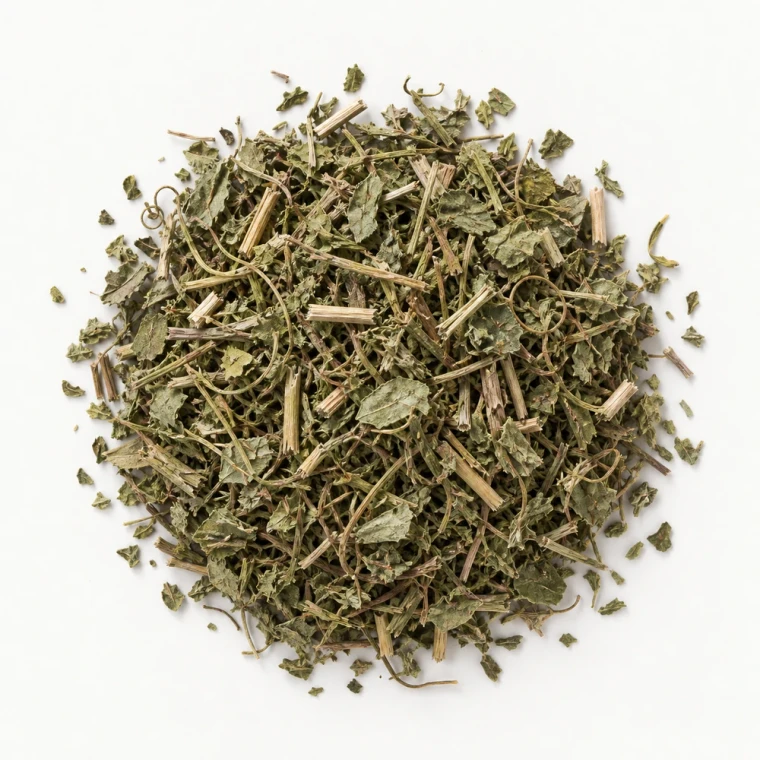
Open ours and you meet several textures at once: flat green-brown leaf fragments, hollow stem pieces, and thin curled tendrils that look like tiny springs. The color runs olive to dull khaki rather than bright green, which is simply how this plant dries and not a sign of age. The smell is faint — dry grass, a little sweetness, nothing loud. It feels light and papery, and it settles rather than compacts.
Why It Does Not Taste Fruity
The name confuses nearly everyone. Sixteenth-century Spanish missionaries in South America looked at the flower's radiating corona and read it as a symbol of the Passion of Christ — the crucifixion, not the fruit. The edible tropical passionfruit comes from a cousin, Passiflora edulis. What you are steeping here is leaf and stem from a temperate vine, and it tastes accordingly: green, dry, faintly sweet, far closer to hay than to anything in the produce aisle. Blend it if you want flavor.
Green, Mild & Hay-Like: Almost no aroma dry, and only a whisper of one wet: cut grass, warm hay, a trace of green tea. The cup pours pale yellow-green and light-bodied, with a soft tannic edge arriving right at the end.
Taste, Texture & Aroma
Mild to the point of shyness. There is a hay sweetness up front, a green vegetal middle, and a faint dryness at the back of the tongue from light tannin, but nothing bitter unless you boil it hard for a long time. The body is thin. Left to cool it stays pleasant rather than turning metallic, which is more than most green-tasting herbs manage.
Blending Passion Flower With Other Herbs
This is a herb that likes company. Its own flavor is quiet enough that almost anything sits comfortably on top of it, and its evening reputation means it usually ends up in a mix built for the last hour before bed.
- With California Poppy — the classic evening pairing. Poppy adds a soft bitterness, and together they make a rounder, fuller cup than either one alone.
- With Lemon Balm — bright lemon over quiet hay. Lemon balm does the tasting while passion flower does the sitting still. Our most-recommended pairing.
- With Catnip Leaf & Flower — both are traditional evening herbs. Catnip brings a minty, musky edge that fills out passion flower's flat middle nicely.
- With Lavender Buds — a pinch only. Lavender turns soapy fast, but a small amount gives the blend the floral top note it badly needs.
- With Oat Straw — sweet, mild and green on green. A gentle nighttime infusion for people who find flavored teas too loud at that hour.
- With Spearmint Leaf — the easiest fix if you find passion flower dull. Spearmint's sweetness carries the whole cup without ever overpowering it.
Who Passion Flower Is Best For
Our Passion Flower is a good fit for:
- People building an evening ritual who want something to pour that is not chamomile again.
- Blenders — this is the quiet base a nighttime mix gets built on top of.
- Anyone who dislikes strong herbal flavors and simply wants a genuinely mild cup.
- Herbalists working traditionally who want the aerial part, cut and sifted, not a capsule or an extract.
- Gardeners in the Southeast curious about the maypop vine already climbing their fence.
How To Use Passion Flower & Make Passion Flower Tea
Use one to two teaspoons per eight ounces. Water just off the boil, covered, five to ten minutes — longer draws more tannin and more dryness, so start at five and work up. Strain, and drink it about an hour before you want to settle rather than at the moment you get into bed. It cold-brews well too: two teaspoons in cold water, refrigerated overnight, then strained.
⚠️ Passion flower is traditionally sedating. Do not use it before driving or operating machinery, do not combine it with sedatives, sleep medication or alcohol, and avoid it during pregnancy. Stop at least two weeks before any scheduled surgery and tell your anesthesiologist you have been using it.
Key Benefits & Everyday Uses: Passion Flower
None of this is a medical claim. It is a record of how passion flower has actually been used: the hour people reach for it, the company it keeps in old formulas, and the shape of the tradition that grew up around it.
- An evening cup — for roughly two centuries this has been the herb poured in the last hour of the day.
- A traditional calming herb — herbalists have long grouped it with lemon balm, catnip and California poppy.
- Caffeine-free by nature — nothing in the plant stimulates, which is exactly why it suits late drinking.
- A blend base — its mildness lets stronger herbs lead without the cup turning into a shouting match.
- Part of a wind-down routine — the ritual of boiling, steeping and sitting down matters as much as the herb does.
- A native plant worth knowing — maypop grows wild across the Southeast, Virginia fence lines very much included.
Passion Flower Details
- Botanical name: Passiflora incarnata
- Plant part: Aerial parts (leaf, stem, tendril and flower)
- Cut: Cut & sifted
- Sizes: 0.5 oz and 1 oz
- Origin: Packed at our Virginia farm-based apothecary
- Contains: 100% passion flower. Nothing else.
Directions For Use
- Use 1 to 2 teaspoons per 8 oz of water.
- Water just off the boil, and keep the cup covered while it steeps.
- Steep 5 to 10 minutes, then strain out the stem and tendril pieces.
- Drink in the evening, never before driving or working.
- Do not combine with sedatives, sleep aids or alcohol.
Storage & Freshness
Airtight, dark and dry. Passion flower fades quietly rather than dramatically: it will not smell rancid, it will simply stop smelling of anything at all, and the cup goes from mild to blank. Keep it out of clear containers on a sunny counter and away from the stove. Use it within a year of opening for the best of it.
Safety Notes & Warnings
Passion flower is traditionally sedating, and that single fact shapes every note below. Read them before your first cup, particularly if you drive, take prescription medication, or have surgery coming up.
- Do not drive or operate machinery after drinking it. Drowsiness is the whole point of the tradition, and it can arrive quietly.
- Avoid during pregnancy. Passion flower is traditionally avoided by pregnant people, and nursing parents should check with a provider first.
- Do not combine it with sedatives, sleep medication, anti-anxiety medication or alcohol. The effects can add up unpredictably.
- Stop at least two weeks before scheduled surgery and tell your anesthesiologist. This is the standard precaution with sedating herbs.
- Talk with your provider first if you take MAOI antidepressants or blood-thinning medication.
- If you have low blood pressure, or feel lightheaded after a cup, stop and reconsider.
Our Virginia Farm-Based Apothecary Approach
Serene Tree Apothecary is a small Virginia farm-based apothecary. We buy our botanicals in small lots, taste and smell every batch before it goes on the shelf, and pack to order so what arrives is fragrant rather than dusty. Nothing here is a filler blend, a flavoring, or a mystery powder — it is one plant, cut and sifted, exactly as it appears on the label.
What Makes Our Passion Flower Different?
A great deal of passion flower on the market is stem-heavy, because stem is what remains once the leaf has been sold somewhere else. We look at that ratio before we buy: you should see plenty of leaf fragment in the cut, not just hollow sticks and dust. Ours is cut and sifted, shaken free of fines, and packed to order in half-ounce and one-ounce amounts so it never sits around losing what little aroma it has.
Why Choose Serene Tree Apothecary Passion Flower?
Small lots, quick turnover, and a person who actually checked the batch. We would rather sell you half an ounce that is still good than an ounce that goes flat in your cupboard. There is no filler here, no flavoring, no proprietary blend and no mystery: just the aerial part of Passiflora incarnata, cut and sifted, weighed out and packed the day your order arrives.
These statements have not been evaluated by the Food and Drug Administration. This product is not intended to diagnose, treat, cure, or prevent any disease. Herbs are traditional foods and botanicals, not medicine. If you are pregnant, nursing, taking prescription medication, or managing a health condition, talk with your healthcare provider before using any herb.
Passion Flower FAQ
Does passion flower tea taste like passionfruit?
No. The edible fruit comes from Passiflora edulis, a tropical cousin. This is leaf and stem from Passiflora incarnata, and it tastes green and hay-like with a mild dryness. If you want fruit flavor, blend it with hibiscus flowers or rose hips.
When should I drink it?
Traditionally in the evening, roughly an hour before you want to be settled rather than at the moment you climb into bed. Never before driving or operating machinery. Because it is sedating by reputation, treat your first cup as an experiment, at home, with nothing to do afterward.
Can I drink it with my sleep medication?
Not without asking your provider first. Passion flower is traditionally sedating, and stacking it on top of prescription sleep aids, anti-anxiety medication, sedatives or alcohol can add up in ways that are hard to predict. This is the most important caution on the page.
Is passion flower safe during pregnancy?
It is traditionally avoided during pregnancy, and we would not recommend it. Nursing parents should also check with a provider before use. If you are pregnant and want a mild evening cup, choose a herb without that history, such as lemon balm or spearmint leaf.
What is maypop?
Maypop is the common American name for Passiflora incarnata, taken from the popping sound the ripe fruit makes underfoot. It is a native perennial vine across the Southeast, Virginia included, and it is exactly the same plant sold as passion flower herb.
Why is mine olive brown instead of bright green?
That is normal. The aerial parts dry to olive, khaki and grey-brown rather than staying vivid, and a batch that looks like fresh spinach is the unusual one. Judge it by aroma instead: faint sweet hay is right, while no smell at all means it is tired.
How strong should I make it?
Start with one teaspoon per eight ounces and five minutes under a lid. Passion flower gets more astringent rather than more flavorful with longer steeping, so if you want a fuller cup, add more herb instead of more time. Two teaspoons at five minutes is a sensible ceiling.
How many cups does an ounce make?
About twenty to twenty-five cups at a teaspoon each, or roughly half that if you brew it at two teaspoons. Half an ounce is the sensible first purchase: enough for a couple of weeks of evenings, and finished well before it starts to fade.