

EXTERNAL USE ONLY — VIRGINIA APOTHECARY
Arnica Flowers is the dried golden-orange flower head of Arnica montana, and it is for external use only — never brewed, never swallowed. Herbalists have infused these flowers into oil for generations, then worked that oil into salves, compresses and liniments for unbroken skin. Keep it out of the teapot and out of reach of children.
External Use OnlyNever brewed, never swallowed — arnica belongs in oil and salve, not a cup.
Unbroken Skin OnlyKeep it off cuts, scrapes and any open or broken skin.
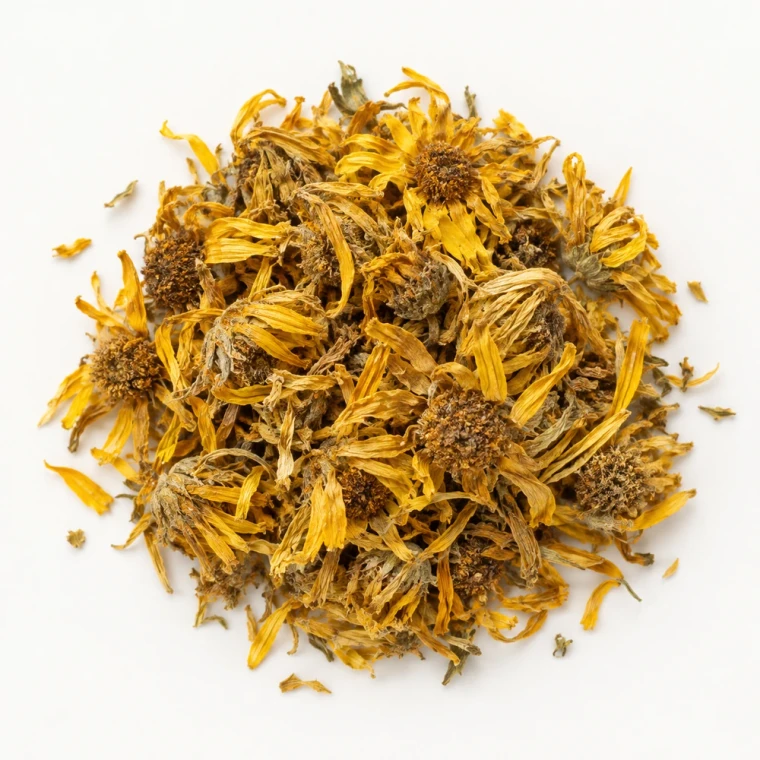
Broken Flower HeadsCut & sifted gold petals, papery calyx and a little seed down.
Packed To OrderTwo sizes, 0.5 oz and 1 oz, filled the week they ship.
What Are Arnica Flowers?
Arnica is a yellow-orange mountain daisy in the Asteraceae family, the same botanical clan as ragweed, chamomile and calendula. The dried flower heads are the part used, and they have a long history in European folk practice as an external preparation — steeped into oil, thickened into salve, or wrung out as a cool compress. Arnica is not a beverage herb. It contains helenalin, a bitter compound that makes swallowing the plant genuinely unsafe.
Meet Our Arnica Flowers
What you open is a loose, feather-light mix of gold and burnt-orange ray petals, papery calyx pieces and a little of the seed down that arnica carries. Cut and sifted means the heads are broken up rather than whole, so the flowers pack down and give up their color to oil quickly. The smell is faintly resinous and herbaceous, closer to dry hay and pine than to a sweet flower.
Why Arnica Oil Needs Dry Flowers
Arnica's useful compounds move into fat far better than into water, which is why the traditional preparation is an oil rather than a brew. That also means moisture is the enemy. Any dampness left in the flowers will sit under the oil and turn it rancid or moldy within weeks. Use flowers that are bone dry, cover them completely so nothing floats above the surface, steep gently, and strain through cloth before it goes into a salve.
Resinous, Bitter & Dry: Dry, resinous and a little dusty, with a bitter green edge you can smell but should never taste. Rubbed between your fingers the petals release a faint pine-and-hay note that carries straight through into an infused oil.
Taste, Texture & Aroma
There is no tasting note here, because arnica is external use only and never goes in a cup. What you judge instead is aroma and texture: dry petals that crumble cleanly, a resinous hay-and-pine smell, no mustiness. In oil, arnica turns the fat a warm gold within a couple of weeks and leaves behind a soft, slightly sticky sediment when you strain.
Blending Arnica Flowers With Other Herbs
Arnica blends the way a salve maker blends, not the way a tea drinker does. Everything below is an external pairing — herbs you infuse into the same oil or steep into the same compress. None of these combinations is meant to be swallowed.
- With Calendula Flowers — the classic salve pair. Calendula is gentle where arnica is strong, and both give up their color to warm oil.
- With Comfrey Leaf — another external-only herb. Together they make the traditional after-the-garden rub that old-time herbalists kept on the porch shelf.
- With Rosemary — rosemary's pine-camphor scent lifts a heavy arnica oil and gives the finished salve a brisk, clean smell instead of a hay smell.
- With Lavender Buds — lavender softens the resinous edge and makes an arnica compress far more pleasant to sit with for ten minutes.
- With St. John's Wort — infused together in oil they turn a deep red-gold. A long-standing external combination in old salve recipes.
- With Mugwort — a bitter, aromatic partner for a footbath or a warm compress, the kind of external soak that ends a long walking day.
Who Arnica Flowers Are Best For
Our Arnica Flowers are a good fit for:
- Salve and balm makers who would rather infuse their own oil than buy a finished cream.
- Gardeners, movers and weekend athletes who like to keep an external rub by the sink.
- Home apothecary builders filling out an external-use shelf alongside comfrey and calendula.
- People who like a compress — a cloth, warm water, ten minutes, unbroken skin only.
- Anyone learning oil infusion, since arnica is forgiving as long as the flowers stay dry.
How To Use Arnica Flowers
External use only — never brew arnica as a tea and never swallow it. For an infused oil, half-fill a clean glass container with flowers, cover them by an inch with olive or sunflower oil, and steep three to four weeks away from light. Strain through cloth. For a compress, steep a tablespoon in a cup of just-boiled water, let it cool, soak a cloth in that liquid, and lay it on unbroken skin. Pour the rest away.
⚠️ External use only. Arnica flowers are unsafe to swallow. Never brew them as a tea, add them to food, or take them internally in any form. Use on unbroken skin only — no cuts, scrapes or broken skin, and nowhere near eyes, nose or mouth. Keep away from children and pets.
Key Benefits & Everyday Uses: Arnica Flowers
None of this is medical advice, and arnica is never taken internally. What follows is simply how country herbalists and salve makers have traditionally reached for these flowers — always on the outside of the body, always on unbroken skin.
- Traditional external rub — infused into oil and used on unbroken skin after digging, hauling or a long day on your feet.
- A salve-maker's staple — arnica oil plus beeswax is one of the oldest external preparations in a home apothecary.
- Cool and warm compresses — a cloth wrung out in arnica water is a very old external comfort measure.
- Liniment tradition — historically steeped in alcohol or witch hazel for external rubs, never for drinking.
- Massage oil base — bodyworkers have long kept an arnica-infused oil on the shelf for external work.
- A good learning herb — a forgiving, straightforward introduction to making your own infused oils at home.
Arnica Flowers Details
- Botanical name: Arnica montana
- Plant part: Flower
- Cut: Cut & sifted
- Sizes: 0.5 oz and 1 oz
- Origin: Packed at our Virginia farm-based apothecary
- Contains: 100% arnica flowers. Nothing else.
Directions For Use
- External use only — never brew, chew or swallow arnica flowers.
- Infuse in oil: cover the flowers completely, steep 3-4 weeks, strain through cloth.
- Apply to unbroken skin only. Stop at the first sign of redness or irritation.
- Patch test on your inner arm and wait a full day before wider use.
- Mark any oil or salve you make clearly for external use, and store it away from children and pets.
Storage & Freshness
Keep the flowers dry, sealed and out of the light. A cool cupboard away from the stove is ideal; heat and steam are what dull the resin and invite mustiness. Whole-flower material like this holds its character for about a year. Any infused oil you make should be kept cool and used within a year.
Safety Notes & Warnings
Arnica has one rule that matters more than all the others: it goes on the skin, never in the body. Read these before you open the pack, and keep it well away from the kitchen.
- External use only. Arnica is unsafe to swallow. Never brew it as a tea, add it to food, or take it internally in any form.
- Unbroken skin only. Do not use on cuts, scrapes or open wounds, and keep it away from the eyes, nose and mouth.
- Arnica sits in the Asteraceae family. If you react to ragweed, daisies, chamomile or marigold, skin reactions are more likely — patch test first.
- Prolonged or repeated application can irritate skin. Use it in short stretches and stop at the first sign of redness.
- Keep away from children and pets, and store it apart from your tea herbs so it is never grabbed by mistake.
- If you are pregnant, nursing, or taking medication, talk with your healthcare provider before using arnica even externally.
Our Virginia Farm-Based Apothecary Approach
Serene Tree Apothecary is a small Virginia farm-based apothecary. We buy our botanicals in small lots, taste and smell every batch before it goes on the shelf, and pack to order so what arrives is fragrant rather than dusty. Nothing here is a filler blend, a flavoring, or a mystery powder — it is one plant, cut and sifted, exactly as it appears on the label.
What Makes Our Arnica Flowers Different?
We buy arnica in small lots and smell every one before it goes on the shelf. Old arnica goes flat and faintly musty; ours should smell green and resinous when you rub a pinch. We keep it on the external-use shelf, physically separate from the tea herbs, and we pack to order in 0.5 oz and 1 oz so it does not sit around losing its character.
Why Choose Serene Tree Apothecary Arnica Flowers?
Because we tell you plainly what arnica is not. Plenty of shops sell it beside the chamomile with no warning at all; we would rather you buy it knowing it belongs in oil and salve and nowhere near a kettle. Beyond that: one plant, cut and sifted, packed to order at a small Virginia farm-based apothecary, in sizes small enough to actually finish.
These statements have not been evaluated by the Food and Drug Administration. This product is not intended to diagnose, treat, cure, or prevent any disease. Herbs are traditional foods and botanicals, not medicine. If you are pregnant, nursing, taking prescription medication, or managing a health condition, talk with your healthcare provider before using any herb.
Arnica Flowers FAQ
Can I make arnica tea?
No. Arnica flowers are for external use only and are unsafe to swallow, so there is no tea, decoction or internal tincture recipe for them. If you want a flower to drink, calendula or elderflower is what you are looking for.
What does external use only actually mean?
It means arnica goes on the outside of the body and nowhere else: infused oils, salves, compresses, liniments and baths. Keep it off broken skin, away from eyes, nose and mouth, and out of anything you plan to eat or drink.
How do I make an arnica infused oil?
Half-fill a clean glass container with dry flowers, cover them by an inch with olive, sunflower or jojoba oil, and steep three to four weeks away from light, shaking every few days. Strain through cloth, press the flowers out, and keep the oil cool.
Is homeopathic arnica the same thing?
No. Homeopathic arnica pellets are diluted to a point where almost none of the plant remains, which makes them a completely different product. What you are buying here is the actual dried flower, which is exactly why the external-use rule applies.
Can I put arnica on a cut or a scrape?
No — unbroken skin only. Broken skin lets far more of the plant through than intended, and arnica can irritate an open wound. Wait until the skin has closed over completely, and stop using it if any redness appears.
How much do I need for a batch of salve?
A half ounce of loose flowers is enough to infuse about a cup of oil, which is plenty for a decent batch of salve. The one ounce size suits anyone who makes oil a couple of times a year or shares it around.
Will arnica irritate sensitive skin?
It can. Arnica belongs to the daisy family, so anyone sensitive to ragweed, chamomile or marigold should patch test on the inner arm and wait a full day. Long, repeated use on one patch of skin causes trouble more often than occasional use.
What is the difference between arnica flowers and arnica oil?
Flowers are the raw material; arnica oil is what you get after steeping them in a carrier oil. Buying the flowers means you choose the carrier, control the freshness, and can infuse calendula or comfrey into the same batch.