
VIRGINIA FARM-BASED APOTHECARY HERBS
Catnip Leaf & Flower is Nepeta cataria, a gray-green mint-family plant leading a double life. To people it is a mild, grassy evening tea with a faint mint edge and none of peppermint's cold. To cats it is nepetalactone — ten minutes of rolling, chirping nonsense, though about a third of them will look at you blankly and walk away.
A Tea And A ToyOne herb, two audiences: evening cup and cat entertainment.
One In Three Opts OutResponse to catnip is inherited. Some cats simply lack it.
Mint Without The ColdGrassy and faintly minty, with no menthol chill at all.
Not In PregnancyTraditionally avoided by anyone pregnant or trying to conceive.
What Is Catnip Leaf & Flower?
Catnip is a hardy mint-family perennial from Europe and Asia, long since naturalized across North America, growing waist-high with soft gray-green leaves and small white flowers freckled with purple. This is the dried leaf and flowering top. People have brewed it as a mild evening tea for centuries — it appears in European herbals as a people's tea long before it appeared as a cat's amusement — and it has been a household garden plant that whole time. Our dried catnip includes both leaf and flower, cut and sifted for cat toys, sachets and a mild, minty herbal tea.
Meet Our Dried Catnip Leaf & Flower
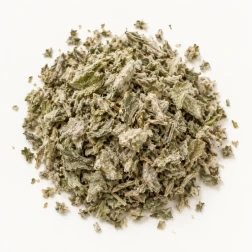
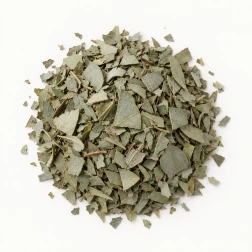
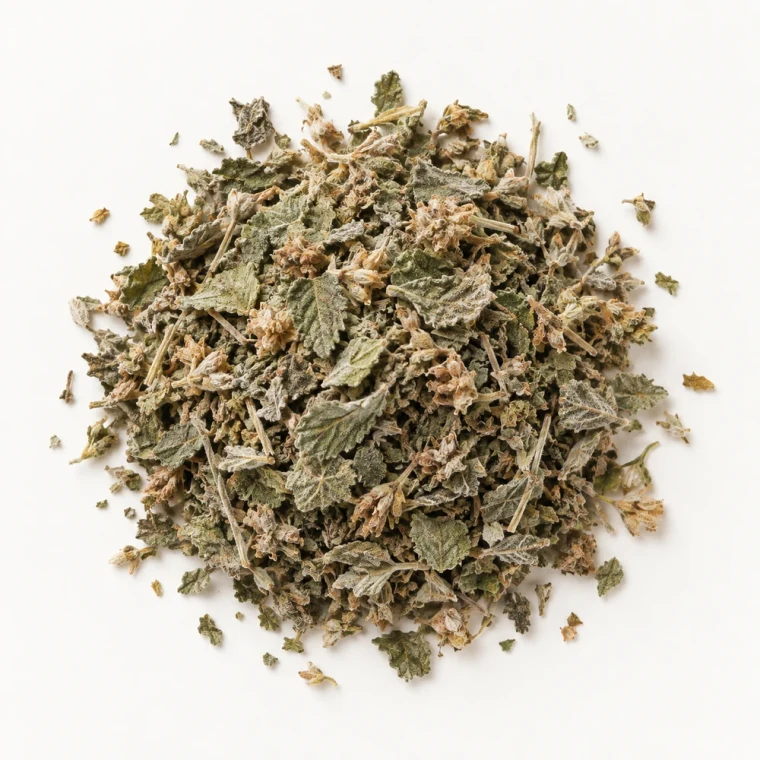
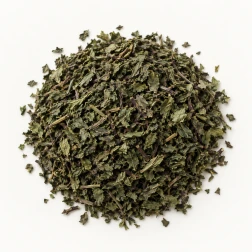
Soft gray-green leaf with a fine, almost velvety texture, mixed through with pale flower buds and short stem. Crush a pinch and the smell comes up grassy and herbal, with a faint mint underneath and something slightly musty behind that. It is not a pretty smell, exactly, and it is unmistakable once you know it. Do that near a cat and you will have company within seconds.
Why A Third Of Cats Ignore It
The active compound is nepetalactone, and a cat meets it through its nose rather than its mouth, which is why cats sniff first and chew second. Whether a cat responds at all is inherited: somewhere between a quarter and a third have no reaction, and kittens under about six months usually do not respond either. A session runs roughly ten minutes, then the switch flips off for an hour or two no matter how much you offer. For non-responders, silver vine is the usual alternative.
Grassy, Minty & Mild: Mint family, but not a mint you would recognize. There is no menthol and no cooling, just a soft grassy green with a faint minty lift and a slightly musty, hay-barn note sitting underneath it.
Taste, Texture & Aroma
A pale yellow-green cup, light-bodied, tasting mostly of green hay with a mint suggestion at the edges. Steeped long it turns noticeably bitter and a little musty, so keep it to five minutes and keep the lid on — the mint character is volatile and leaves with the steam. Honey suits it. Lemon suits it better. Most people find it pleasant rather than delicious, which is a fair verdict.
Blending Catnip Leaf & Flower With Other Herbs
Catnip is mild enough to make up half a blend and quiet enough that almost anything sits well on top of it. Since its own musty edge is the part people like least, most good catnip blends are built to cover exactly that.
- With Lemon Balm — the best fix there is. Lemon balm's citrus covers the musty note completely, and both are traditional evening herbs, so nothing clashes.
- With Spearmint Leaf — catnip is a mint with no mint flavor; spearmint supplies the sweetness and the cool that catnip is missing.
- With Passion Flower — two mild evening herbs, both hay-like. Equal parts makes a soft, undramatic bedtime cup with no bitterness at all.
- With Lemongrass — bright and clean against catnip's hay. A third lemongrass turns a dull cup into something you would actually pour again.
- With Oat Straw — both are green and undemanding. Oat straw adds body and a soft sweetness without covering catnip's own character.
- With Elderflower — elderflower's light honey note lifts catnip without adding weight. A gentle blend for the last hour of the evening.
Who Catnip Leaf & Flower Is Best For
Our Catnip Leaf & Flower is a good fit for:
- Cat people stuffing toys, refreshing scratchers, or making a bored indoor cat's afternoon.
- Anyone who wants a mild evening tea that is not chamomile and not another mint.
- People who keep a garden for pollinators — catnip flowers are covered in bees all summer.
- Blenders building a bedtime mix who need a soft green base rather than a strong flavor.
- Households that would rather buy one herb that does two jobs than two half-used ones.
How To Use Catnip Leaf & Flower
For tea, 1 to 2 teaspoons per 8 oz, water just off the boil, covered, 5 minutes, then strained — cover it, or the mint note goes up with the steam. For a cat, a pinch on the floor, rubbed into a scratcher, or sealed inside a stuffed toy. Crush it first; the smell is what matters. Offer it once every few days rather than daily, or they stop caring.
⚠️ Not for use in pregnancy. Catnip is traditionally regarded as a uterine stimulant and is avoided by anyone pregnant or trying to conceive; check with your provider before drinking it while nursing. It is also a mint-family herb, so skip it if you react to mint, oregano or basil — and do not drink it before driving, since it has always been a settling herb.
Key Benefits & Everyday Uses: Catnip Leaf & Flower
Traditional uses, told as tradition. Catnip has been a garden plant and a teacup herb in Europe far longer than it has been a cat toy in North America, and both histories are worth knowing.
- A traditional evening tea — mild, grassy and poured after dinner, a European household habit for centuries.
- The cat herb — nepetalactone, ten minutes of enthusiasm, and a genuinely useful tool for a bored indoor cat.
- Toys, scratchers and boxes — a pinch rubbed in refreshes a cardboard scratcher that has stopped being interesting.
- A pollinator plant — if you sow the seed, catnip flowers hum with bees from midsummer on.
- A mint that is not minty — useful in blends where you want green softness without menthol.
- An old kitchen-garden staple — catnip stood in European herb beds long before anyone thought of it as a pet product.
Catnip Leaf & Flower Details
- Botanical name: Nepeta cataria
- Plant part: Leaf and flowering top
- Cut: Cut & sifted
- Sizes: 0.5 oz and 1 oz
- Origin: Packed at our Virginia farm-based apothecary
- Contains: 100% catnip leaf & flower. Nothing else.
Directions For Use
- Tea: 1–2 teaspoons per 8 oz, just off the boil, covered, 5 minutes, strained.
- Keep the lid on while it steeps — the mint character leaves with the steam.
- For cats: crush a pinch, scatter it, rub it into a scratcher, or seal it in a toy.
- Space cat sessions a few days apart; offered daily, most cats lose interest.
- Do not use in pregnancy, and do not drink it before driving.
Storage & Freshness
Airtight, cool, dark and dry — and if you have cats, somewhere with a lid they cannot work loose. Nepetalactone is volatile and fades faster than most aromatics, so catnip that has sat open for a year will bore a cat completely. Six months to a year is a fair working life. Crush a pinch to check.
Safety Notes & Warnings
Catnip is mild, but mild is not the same as unrestricted. These notes cover both the people in the house and the cat. If you are pregnant or taking medication, talk with your provider first.
- Avoid during pregnancy. Catnip has a long traditional reputation as a uterine stimulant and is set aside by anyone pregnant or trying to conceive. Ask your provider before drinking it while nursing.
- Mint-family allergy: catnip is a Lamiaceae plant alongside mint, oregano, thyme and basil. Skip it if those bother you.
- It has always been a settling herb — do not drink it before driving, and be careful about combining it with sedatives or alcohol.
- Stop before scheduled surgery and mention it to your anesthesiologist, as you would with any calming herb.
- For cats, a pinch is plenty. Too much at once can leave a cat queasy, and a cat that eats a large amount may vomit.
- Kittens under about six months usually do not respond, and catnip is no substitute for a veterinarian's advice about a cat's behavior.
Our Virginia Farm-Based Apothecary Approach
Serene Tree Apothecary is a small Virginia farm-based apothecary. We buy our botanicals in small lots, taste and smell every batch before it goes on the shelf, and pack to order so what arrives is fragrant rather than dusty. Nothing here is a filler blend, a flavoring, or a mystery powder — it is one plant, cut and sifted, exactly as it appears on the label.
What Makes Our Catnip Leaf & Flower Different?
Most dried catnip sold for pets is stem, dust and whatever was left at the bottom of the bin, which is why so many cats ignore it and then get blamed for being non-responders. Ours is cut and sifted toward leaf and flower, where the nepetalactone actually lives, and it is good enough to brew as well as to scatter. We buy in small lots and pack to order, because this one fades fast.
Why Choose Serene Tree Apothecary Catnip Leaf & Flower?
One plant, cut and sifted, nothing added — the same catnip whether it ends up in a teapot or a stuffed mouse. We sell it in 0.5 oz and 1 oz because catnip loses its punch faster than almost anything else on this shelf, and a small amount you finish beats a big one that goes quiet. Packed to order, by a small Virginia farm-based apothecary.
These statements have not been evaluated by the Food and Drug Administration. This product is not intended to diagnose, treat, cure, or prevent any disease. Herbs are traditional foods and botanicals, not medicine. If you are pregnant, nursing, taking prescription medication, or managing a health condition, talk with your healthcare provider before using any herb.
Catnip Leaf & Flower FAQ
Why doesn't my cat react to catnip?
Because the response is inherited, and somewhere between a quarter and a third of cats simply do not carry it. Kittens under about six months usually do not respond either, even if they will later. It is not a sign of bad catnip or a dull cat.
How long does the effect last?
About ten minutes, then it switches off, and most cats cannot respond again for an hour or two no matter how much you put in front of them. Offering it every day dulls the response, so a session every few days keeps it interesting.
Can people drink catnip tea?
Yes, and in Europe people drank it long before it became a pet product. It brews a pale, grassy, faintly minty cup and has traditionally been an evening herb. One to two teaspoons per 8 oz, covered, five minutes. Not during pregnancy, and not before driving.
Does it taste like mint?
Barely. Catnip is in the mint family but has no menthol at all, so there is none of peppermint's cold. What you get is green hay with a faint minty lift and a slightly musty note underneath. Lemon Balm or Spearmint Leaf covers that last part neatly.
Is catnip safe for cats?
It is widely regarded as safe and non-addictive, and cats self-regulate: they walk away when they are done. A pinch is plenty. A cat that eats a large quantity may end up queasy or vomiting, so keep it closed and out of reach between sessions.
My catnip stopped working. Why?
Almost always because it went stale. Nepetalactone is volatile and disappears from an open container faster than most aromatics, so a year on a shelf can leave you with green confetti. Crush a pinch: if you cannot smell it, the cat cannot either. Store it sealed and cool.
Is there an alternative for cats that don't respond?
Silver vine, sometimes sold as matatabi, is the usual one, and it reaches a good share of cats that ignore catnip entirely. Tatarian honeysuckle and valerian root are the other two commonly tried. We do not carry them, but any decent pet supplier will.
Can I use it while pregnant?
No. Catnip is traditionally avoided in pregnancy and by anyone trying to conceive, on the strength of a long-standing reputation as a uterine stimulant. If you are nursing, ask your provider before drinking it. Handling it for the cat is a different matter entirely.