

VIRGINIA FARM-BASED APOTHECARY HERBS
St. John's Wort is Hypericum perforatum, the yellow midsummer flower whose dried tops hide a red pigment that bleeds ruby into oil. It is also the most interaction-prone herb on our shelf: it changes how the liver clears many prescription drugs, from birth control to blood thinners. Talk to your pharmacist or prescriber before using this if you take any prescription medication.
Ask Your PharmacistIt interacts with many prescription drugs, including birth control.
Turns Oil Ruby RedThe tops carry hypericin, which stains infused oil a deep red.
Sun SensitivityIt can make skin burn faster. Go easy on strong sun.
Midsummer FlowerNamed for St. John's Day, June 24, when it comes into bloom.
What Is St. John's Wort?
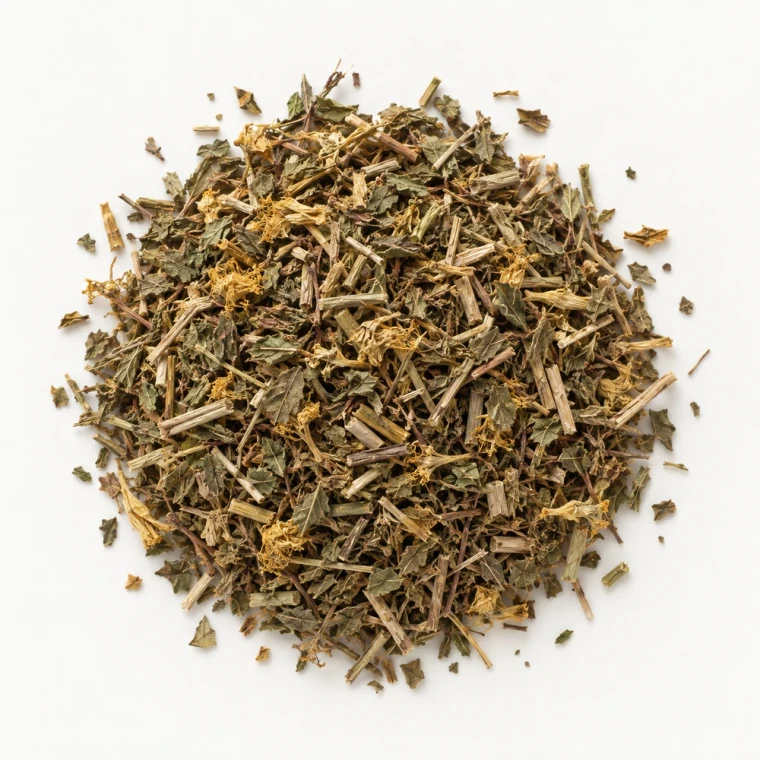
St. John's wort is a shrubby perennial of roadsides and old pastures, blooming yellow around midsummer across Europe and much of North America. This is the dried flowering top: buds, open flowers, small leaves and fine stem, cut and sifted together. Herbalists have reached for it for centuries, most often as an infused oil rubbed into tired shoulders, and more recently as a tea or extract. The Latin name refers to the leaf, which looks perforated when held up to light. Brewed as St. John's wort tea, it makes a mild, slightly bitter herbal cup; if you take any medication, check with your healthcare provider first, as it interacts with many.
Meet Our St. John's Wort
Tip a spoonful into your palm and it is olive-brown and papery, with knots of small dried buds, a scatter of faded yellow petals and short lengths of wiry stem. Crush a bud between your fingers and you may see a faint purple-red smear. That is hypericin, sitting in the dark dots along the petal edges. The smell is dry and faintly balsamic, more hay barn than flower garden.
Why It Stains Oil Ruby Red
Look at the buds and you will find tiny black dots. Those are glands full of hypericin, a red pigment, and they are the reason for the plant's most famous party trick: pack fresh or dried tops into a jar of olive oil, leave it in a warm window for a few weeks, and the oil turns a deep ruby red. Herbalists have made that oil for centuries. It will stain cloth, counters and fingers, so work over something you do not mind marking.
Grassy, Dry & Bitter: A quiet, hay-like herb with a dry bitterness underneath. Nothing floral survives the drying, so what is left tastes green and slightly astringent, closer to a mouthful of meadow than to tea. It finishes clean and a little tannic.
Taste, Texture & Aroma
Brewed alone it makes a pale gold-green cup that smells of dry hay and tastes mostly of it. There is a light bitterness at the back and a tannic grip that builds with longer steeping, so five minutes is usually better than ten. No sweetness, no perfume, nothing fruity. Honey helps. So does a mint or a lemon herb sitting alongside it in the mix.
Blending St. John's Wort With Other Herbs
Before you blend anything with St. John's wort, settle the medication question. The interactions travel with the herb into whatever cup it lands in. Once that is clear, it is a mild, hay-like base that takes brighter herbs easily.
- With Lemon Balm — a long-standing evening pairing. Lemon balm's bright citrus lifts the hay note, and the two make a far more drinkable cup than either alone.
- With Oat Straw — both are mild, green and grassy. Oat straw's soft sweetness rounds off the tannic edge without covering anything up.
- With Lavender Buds — a scant pinch is enough. Lavender gives the blend the floral note St. John's wort loses entirely in the drying.
- With Calendula Flowers — for infused oil rather than the teapot. Both give up gold and red pigment to oil, and the result is a striking color.
- With Arnica Flowers — external use only, never a tea. Infused together in oil they turn deep red-gold, a pairing found all through old salve recipes.
- With Peppermint Leaf — mint does the heavy lifting on flavor. One part St. John's wort to two of peppermint makes the hay note almost disappear.
Who St. John's Wort Is Best For
Our St. John's Wort is a good fit for:
- Oil infusers and salve makers — the ruby-red oil is the classic reason people buy this herb.
- People who take no prescription medication and want the traditional midsummer tea herb.
- Herb gardeners and folk-craft makers working with a plant that carries a great deal of history.
- Blenders who want a mild, grassy base for an evening mix with brighter herbs on top.
- Anyone who would rather have the cautions stated plainly than buried at the bottom of a page.
How To Use St. John's Wort & Make St. John's Wort Tea
Talk to your pharmacist or prescriber before using this if you take any prescription medication. If you are clear, use 1 teaspoon per 8 oz, water just off the boil, covered, 5 to 10 minutes, then strain. For infused oil, pack a jar loosely, cover with olive oil, cap it, and leave it in a warm window three to six weeks before straining. Wear sunscreen either way.
⚠️ Talk to your pharmacist or prescriber before using this if you take any prescription medication. St. John's wort speeds up the liver enzymes and transport proteins that clear many drugs from the body, which can make those drugs stop working. That includes hormonal birth control, blood thinners, transplant anti-rejection drugs, HIV medications and some cancer medications. Combined with SSRIs and other antidepressants, triptans or tramadol it can also push serotonin too high, which is a serious reaction. It causes sun sensitivity as well, so cover up or wear sunscreen while you use it.
Key Benefits & Everyday Uses: St. John's Wort
Everything below is traditional use, described as tradition. It is not a medical claim, and it is not a reason to change anything a prescriber has told you. St. John's wort has been a midsummer herb of European folk practice for a very long time.
- The classic red infused oil — pressed into oil and used externally on tired shoulders and backs for centuries.
- A midsummer harvest tradition — cut around St. John's Day, June 24, and hung to dry, a habit older than the written herbals.
- A traditional evening tea herb — mild, grassy, and almost always blended with something brighter.
- A folk-craft plant — bundles, wreaths and doorway sprigs at midsummer across much of Europe.
- An unmistakable pigment plant — hypericin gives red to oil and alcohol, which makes it a favorite of people who make things.
- A closely documented herb — few plants have been examined as carefully, which is exactly why its drug interactions are so well known.
St. John's Wort Details
- Botanical name: Hypericum perforatum
- Plant part: Flowering top
- Cut: Cut & sifted
- Sizes: 0.5 oz and 1 oz
- Origin: Packed at our Virginia farm-based apothecary
- Contains: 100% st. john's wort. Nothing else.
Directions For Use
- Talk to your pharmacist or prescriber first if you take any prescription medication.
- Tea: 1 teaspoon per 8 oz, water just off the boil, covered, 5–10 minutes, strained.
- Infused oil: pack a jar loosely, cover with olive oil, warm window, 3–6 weeks, then strain. External use.
- Wear sunscreen and cover up — St. John's wort makes skin burn more easily.
- Do not use it in pregnancy or while nursing, and stop two weeks before any surgery.
Storage & Freshness
Airtight, cool, dark and dry. Light is the real enemy here — hypericin fades in sun, and a container left on a bright shelf will lose its color long before its smell. Kept dark, expect a good year. Keep it away from cloth and pale surfaces, because the pigment stains.
Safety Notes & Warnings
This is the most interaction-prone herb we carry, and the cautions are not theoretical. Please read all of them, and check with your pharmacist or prescriber before you use it alongside anything.
- Talk to your pharmacist or prescriber before using this if you take any prescription medication. St. John's wort induces the CYP3A4 enzyme system and the P-glycoprotein transporter, which is how the body clears a very large share of prescription drugs.
- It can make hormonal birth control less effective. That includes the pill, the patch, the ring and hormonal implants. Breakthrough bleeding and unintended pregnancies have been reported.
- Do not combine it with antidepressants. With SSRIs, SNRIs, MAOIs, triptans or tramadol it can push serotonin too high, a reaction that can be serious and needs medical care.
- It interferes with blood thinners, transplant anti-rejection drugs, HIV medications and several cancer medications, along with digoxin, some statins and some seizure medications. This list is not complete. Ask your pharmacist.
- It causes photosensitivity. Skin and eyes burn more easily in sun and in tanning beds, particularly for fair-skinned people. Cover up, wear sunscreen, and consider sunglasses.
- Avoid in pregnancy and while nursing. Stop at least two weeks before scheduled surgery and tell your anesthesiologist. Never stop a prescribed medication in order to take an herb.
Our Virginia Farm-Based Apothecary Approach
Serene Tree Apothecary is a small Virginia farm-based apothecary. We buy our botanicals in small lots, taste and smell every batch before it goes on the shelf, and pack to order so what arrives is fragrant rather than dusty. Nothing here is a filler blend, a flavoring, or a mystery powder — it is one plant, cut and sifted, exactly as it appears on the label.
What Makes Our St. John's Wort Different?
Most St. John's wort on the market is sold with a cheerful mood claim and no mention of the pharmacology. We do it the other way around: the interaction list sits at the top of this page, not the bottom, because that is the honest order. What we sell is the flowering top, cut and sifted, with the buds still visible in the mix, bought in small lots and packed to order.
Why Choose Serene Tree Apothecary St. John's Wort?
We would rather lose a sale than have someone find out about these interactions afterward. If you take a prescription medication, please talk to your pharmacist before you buy this — and if the answer is no, buy Lemon Balm or Oat Straw instead. If the answer is yes, what you get here is one plant, cut and sifted, no fillers, packed to order in the size you will finish.
These statements have not been evaluated by the Food and Drug Administration. This product is not intended to diagnose, treat, cure, or prevent any disease. Herbs are traditional foods and botanicals, not medicine. If you are pregnant, nursing, taking prescription medication, or managing a health condition, talk with your healthcare provider before using any herb.
St. John's Wort FAQ
Does St. John's wort interact with medications?
Yes, more than any other herb we carry. It speeds up CYP3A4 and P-glycoprotein, the liver enzyme system and transport protein that clear a large share of prescription drugs, so those drugs can drop below the level they need to work. Talk to your pharmacist or prescriber before using this if you take any prescription medication.
Can I take it with birth control?
Not without talking to your prescriber. St. John's wort is well documented to reduce the effectiveness of hormonal contraception — the pill, the patch, the ring and implants — and breakthrough bleeding and unintended pregnancies have been reported. If you rely on hormonal birth control, this is a conversation to have first, not after.
Can I take it with an antidepressant?
Not without a prescriber's supervision. Combined with SSRIs, SNRIs, MAOIs, triptans or tramadol, St. John's wort can raise serotonin too far, a reaction that can become serious quickly. Never add it to an antidepressant on your own, and never stop a prescribed antidepressant in order to try it.
Why does the oil turn red?
Hypericin, a pigment stored in the tiny black dots on the buds and petals. Pack the tops into oil, leave the jar somewhere warm and bright for three to six weeks, and the oil draws the pigment out and goes ruby. That oil is for external use, and it stains everything it touches.
Will it make me sunburn?
It can. Hypericin makes skin and eyes more reactive to ultraviolet light, and fair-skinned people notice it most. If you use it, wear sunscreen, cover up on bright days, skip tanning beds and consider sunglasses. Livestock that graze heavily on the plant get the same reaction, which is how the effect was first noticed.
Why is it called St. John's wort?
Because it flowers around St. John's Day, June 24, close to midsummer, and traditionally that is when it was cut. Wort is simply the old English word for a useful plant, the same one you see in mugwort, soapwort and lungwort. It has nothing to do with warts.
What does perforatum mean?
Hold a fresh leaf up to the light and it looks pricked full of pinholes. Those are translucent oil glands rather than actual holes, but they gave the plant its species name. It is also the quickest way to tell true Hypericum perforatum from its many look-alike cousins.
What does it taste like, and what should I blend it with?
Dry and grassy, like hay, with a light bitterness and a tannic finish. Nothing floral survives drying. Lemon Balm is the pleasantest partner, Peppermint Leaf the most effective at covering the hay note, and Oat Straw the gentlest. Keep the steep to five minutes to hold the tannin down.