


VIRGINIA FARM-BASED APOTHECARY HERBS
Hyssop Herb is Hyssopus officinalis, a low woody mint-family plant with blue flower spikes and one of the longest garden histories in Europe. The flavor is sharp — camphor, mint and a clean bitterness, all at once — and it takes very little. Use a light hand; skip it in pregnancy and if you are prone to seizures.
Use A Light HandA quarter teaspoon is plenty. Hyssop overwhelms a cup fast.
Monastery Garden HerbGrown in cloister beds for a thousand years, and still grown.
Not The Bible's HyssopThe plant in scripture was almost certainly a different herb.
Not In PregnancyAvoid if pregnant, and avoid if you are prone to seizures.
What Is Hyssop Herb?
Hyssop is a small woody perennial in the mint family, native to southern Europe and the Middle East, growing knee-high with narrow leaves and dense spikes of blue-violet flowers that bees work all summer. This is the dried leaf and flowering top. It has been grown in kitchen and monastery gardens since at least the Middle Ages, used sparingly in cooking, in vinegars and honeys, in steam bowls, and — famously — in the liqueurs the monasteries made.
Meet Our Hyssop Herb
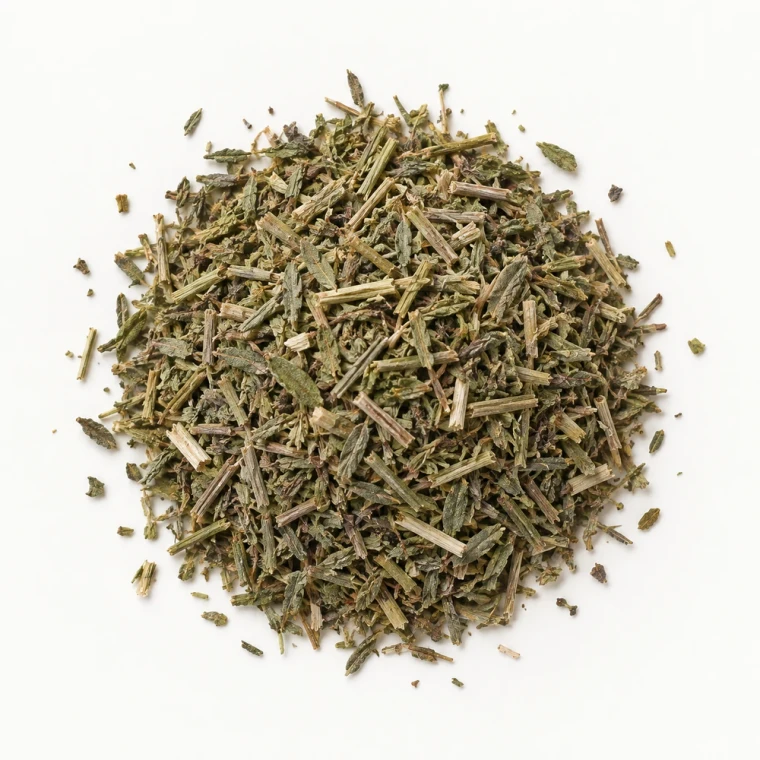
Narrow dark-green leaves, brittle and needle-like once dried, with short lengths of woody stem and, if the lot was a good one, small twists of dried blue-purple flower scattered through. Crush a pinch and the smell hits at once: camphor first, then mint, then something almost medicinal behind it, closer to a cough drop than to a salad. It is a strong smell for such a small leaf.
Probably Not The Bible's Hyssop
The hyssop named in the Old Testament is almost certainly not this plant. Hyssopus officinalis does not grow wild in the region the text describes, and most scholars now read the Hebrew ezov as Syrian oregano, a related mint-family plant with the right habit of growing out of walls. The name transferred across in early Greek and Latin translation and stuck. Worth knowing if you came looking for a piece of scripture; what you have instead is a fine old European garden herb.
Sharp, Camphorous & Bitter: Loud for its size. Camphor and mint arrive together, followed by a clean, drying bitterness that hangs around. There is a faint sweetness underneath if you look for it, but sharpness is the whole personality here.
Taste, Texture & Aroma
A quarter teaspoon makes a clear golden cup that tastes cool and clean and finishes bitter. A full teaspoon makes something most people put down after two sips. That is the whole story with hyssop: the difference between pleasant and punishing is about a pinch. In food it behaves the same way — a little lifts a fatty dish, a lot tastes like medicine.
Blending Hyssop Herb With Other Herbs
Hyssop is an accent, never a base. Keep it to a tenth or a fifth of any mix and let something softer carry the cup. That is exactly how the old monastery recipes used it: as one sharp voice inside a crowd.
- With Mullein Leaf — mullein is soft and neutral, which is exactly what hyssop needs underneath it. One part hyssop to four makes a clean cold-season steam.
- With Eucalyptus Leaf — an old European steam pairing. Hyssop's minty bitterness gives depth underneath eucalyptus, which on its own reads as all top note.
- With Marshmallow Leaf — marshmallow's soft mucilage takes the scrape off hyssop's finish. A pinch of hyssop to a heaping teaspoon of marshmallow.
- With Oregano — two sharp mint-family herbs. A pinch of each in a winter vinegar makes a bracing, savory base for a shrub or a dressing.
- With Rose Hips — tart fruit against hyssop's camphor. The sourness gives the blend something to push against, and the color is lovely.
- With Elderflower — a classic cold-season pairing in old European practice. Elderflower's honeyed lightness softens hyssop's edge without canceling it.
Who Hyssop Herb Is Best For
Our Hyssop Herb is a good fit for:
- Herb gardeners and history readers who want the actual monastery-garden plant.
- People building a cold-season steam shelf and needing one sharp, camphorous herb in it.
- Bitters, vinegar and liqueur makers — hyssop is named in most accounts of the classic monastery liqueurs.
- Cooks who want a small sharp accent for fatty meat, game, beans or a winter dressing.
- Confident blenders who already know how to keep a strong herb down to a tenth of a mix.
How To Use Hyssop Herb
Start at ¼ teaspoon per 8 oz — half of what you would use for almost any other herb — with water just off the boil, covered, 5 minutes, then strained. Longer gives you more bitterness, not more flavor. For a steam, a scant teaspoon in a bowl of hot water under a towel. In cooking, a pinch, added early, to fatty meat or beans. Not for daily long-term use.
⚠️ Avoid hyssop in pregnancy, and avoid it entirely if you have a seizure disorder or are prone to seizures. Hyssop's aromatic oil contains pinocamphone, which at high doses has been associated with convulsions. The concentrated essential oil is the sharp end of that, but the caution extends to strong preparations of the herb. Keep amounts small, use it in short stretches rather than daily, and talk with your provider if you take medication.
Key Benefits & Everyday Uses: Hyssop Herb
Traditional uses, told as tradition and nothing more. Hyssop's record is a garden record — cloister beds, kitchen vinegars, steam bowls and liqueur recipes — and it is one of the better-documented European herbs for exactly that reason.
- A monastery-garden staple — grown in European cloister beds for a thousand years, and named in most accounts of the great herbal liqueurs.
- A traditional steam herb — a scant teaspoon in a bowl of hot water is an old cold-season habit.
- Vinegars, honeys and bitters — hyssop gives its sharp character up readily to both alcohol and vinegar.
- A small culinary accent — a pinch cuts through fatty meat, game and heavy bean dishes much the way sage does.
- One of the best bee plants there is — if you grow it, the flower spikes are covered from midsummer on.
- A strong herb that stretches — used at a quarter teaspoon, half an ounce lasts a very long time.
Hyssop Herb Details
- Botanical name: Hyssopus officinalis
- Plant part: Leaf and flowering top
- Cut: Cut & sifted
- Sizes: 0.5 oz and 1 oz
- Origin: Packed at our Virginia farm-based apothecary
- Contains: 100% hyssop herb. Nothing else.
Directions For Use
- Tea: ¼ teaspoon per 8 oz, just off the boil, covered, 5 minutes, strained. Start small.
- Blend it — keep hyssop to a tenth or a fifth of any mix.
- Steam: a scant teaspoon in a bowl of hot water, towel over your head, eyes closed.
- Cooking: a pinch, added early, to fatty meat, game, beans or a winter vinegar.
- Not in pregnancy, and not if you are prone to seizures. Use it in short stretches, not daily.
Storage & Freshness
Airtight, cool, dark and dry. Hyssop is resinous enough to hold its aroma better than a soft leaf, but the camphor note is the first thing to go, and it is the thing you are buying. A year is a fair working life. Store it away from milder herbs, because the smell travels.
Safety Notes & Warnings
Hyssop is a strong aromatic herb with real cautions attached, and it is not one to drink daily for months. Please read these before you brew anything, particularly the note about seizures.
- Avoid entirely if you have a seizure disorder or are prone to seizures. Hyssop's oil contains pinocamphone, associated with convulsions at high doses. The essential oil is the sharp end of that, but the caution stands for the herb.
- Do not use it in pregnancy, and check with your provider before using it while nursing.
- Not for long continuous use. Hyssop is a short-stretch herb: small amounts for a week or two at a time, rather than a daily beverage.
- Mint-family allergy: hyssop is a Lamiaceae herb alongside oregano, thyme, mint and sage. Skip it if those bother you.
- Hyssop essential oil is a different product entirely and is not what you are buying here. It should never be swallowed.
- Not for children, and worth clearing with your provider if you take medication for blood pressure or for the nervous system.
Our Virginia Farm-Based Apothecary Approach
Serene Tree Apothecary is a small Virginia farm-based apothecary. We buy our botanicals in small lots, taste and smell every batch before it goes on the shelf, and pack to order so what arrives is fragrant rather than dusty. Nothing here is a filler blend, a flavoring, or a mystery powder — it is one plant, cut and sifted, exactly as it appears on the label.
What Makes Our Hyssop Herb Different?
Hyssop is mostly woody stem on the plant, and stem is what usually gets sold. We sift ours toward leaf and flowering top, so the blue-purple flower is still visible in the cut and a quarter teaspoon actually delivers something. We buy in small lots and crush a pinch from each one before it goes on the shelf — with hyssop, that test takes about a second.
Why Choose Serene Tree Apothecary Hyssop Herb?
We will tell you honestly that most people should buy the 0.5 oz size of hyssop. You use it a quarter teaspoon at a time, half an ounce lasts a season, and it is not an herb anyone drinks by the mug. What we can promise is a clean, aromatic cut with the flower still in it, one plant and nothing else, and the cautions said out loud.
These statements have not been evaluated by the Food and Drug Administration. This product is not intended to diagnose, treat, cure, or prevent any disease. Herbs are traditional foods and botanicals, not medicine. If you are pregnant, nursing, taking prescription medication, or managing a health condition, talk with your healthcare provider before using any herb.
Hyssop Herb FAQ
Is this the hyssop from the Bible?
Almost certainly not. Hyssopus officinalis does not grow wild in the region described, and scholars generally read the Hebrew ezov as Syrian oregano, a wall-growing mint-family plant. The name crossed over in early Greek and Latin translation and never crossed back. This is the European garden herb.
How much should I use?
Less than you think: a quarter teaspoon per 8 oz to start, steeped five minutes, covered. Hyssop is one of the few herbs where a full teaspoon makes a cup most people cannot finish. In a blend, keep it to a tenth or a fifth of the total.
Why should people prone to seizures avoid it?
Hyssop's aromatic oil contains pinocamphone and isopinocamphone, which at high doses have been associated with convulsions. The concentrated essential oil is the real risk and the dried herb is far weaker. Even so, the standard herbal caution is to avoid hyssop entirely with any seizure disorder, and we agree with it.
What does hyssop taste like?
Camphor and mint arriving together, then a clean drying bitterness at the finish — closer to a cough drop than to a garden herb. There is a faint sweetness under it. Used at a quarter teaspoon it is bracing and pleasant. Used at a full teaspoon it is not.
Is hyssop really in Chartreuse?
The full recipe is a famously guarded secret, so nobody outside the order can say for certain. Hyssop appears in nearly every published account of the botanicals, and it turns up in descriptions of Bénédictine as well. Both liqueurs came out of monastery still-rooms, where hyssop was already growing in the garden outside.
Can I cook with hyssop?
Yes, sparingly. It works the way sage does: a pinch against fatty meat, game, duck, sausage, beans or a heavy winter stew, added early enough to soften. It also makes a bracing vinegar. Past a pinch it tastes medicinal, so handle it as a seasoning rather than a leafy herb.
Can I drink it every day?
We would not. Hyssop is a short-stretch herb in traditional practice — small amounts for a week or two at a time rather than a daily beverage — and that is how we would use it. If you want something to drink every day, Marshmallow Leaf or Oat Straw is a much better fit.
What should I blend it with?
Something soft and neutral that can carry the cup. Mullein Leaf and Marshmallow Leaf are the two best partners, at four or five parts to one of hyssop. For a steam, Eucalyptus Leaf. For a vinegar, Oregano. Rose Hips give it a tartness to push against.
