
Posted by Marco Graham on Aug 18th 2026
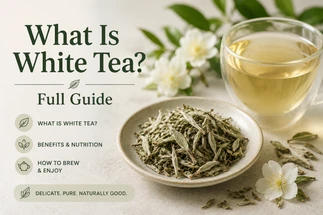
What Is White Tea? Full Guide
✿ The Gentlest Tea There Is
What Is White Tea? A Complete Guide to the World's Least Processed Tea
White tea is the quietest thing in the tea cupboard. It is made from the youngest buds and leaves of the tea plant, barely handled after picking, and dried rather than rolled, fired or oxidized. The result is a pale, softly sweet cup with almost no astringency, and a category that most tea drinkers have never properly explored.
What White Tea Actually Is
White tea comes from Camellia sinensis, the same plant that gives us green, oolong, black and pu-erh. What separates the six tea types is not the plant but the processing, and white tea is defined by how little of it there is.
Black tea is withered, rolled, fully oxidized and fired. Green tea is heated early to stop oxidation, then shaped. White tea skips nearly all of that. The leaves are picked, laid out to wither, and dried. No pan-firing, no rolling, no bruising, no deliberate oxidation. Two steps instead of five.
That minimal handling is the whole point. Because the leaf is never broken, the compounds inside it are never forced out in a rush, which is why white tea tastes soft and sweet where green tea tastes vegetal and black tea tastes malty. It is also why the dried leaves still look like leaves, covered in the fine silvery down that gives the category its name. That white fuzz is trichomes, the tiny hairs on an unopened tea bud, and it is the first thing you notice when you open a good bag.
The style originates in Fujian province in southeastern China, where the Da Bai and Da Hao cultivars produce the plump, downy buds the category depends on. Fuding and Zhenghe are the two counties most associated with it. White tea is now made in India, Sri Lanka, Nepal and elsewhere, but the Fujian classics remain the reference point. If you want the wider family tree, our guide to the types of tea lays all six side by side.
✿ Know Your Grades
The Types of White Tea
White tea is graded by what part of the plant goes into it. The more unopened buds, the higher the grade, the more delicate the cup, and the higher the price.
Silver Needle (Yin Zhen)
The top grade, and the most prized white tea in the world. Nothing but unopened buds, hand-picked over a short window each spring, each one covered in silver down. Light bodied, silky, naturally sweet, with a soft floral character and an exceptionally clean finish. Our Organic Silver Needle is the one to reach for when you want tea that feels like a reset.
White Peony (Bai Mu Dan)
Buds plus the first one or two tender leaves. That extra leaf gives it more body and a little more depth than Silver Needle, with gentle floral notes and a light honeyed sweetness. It is the everyday white tea, elegant but not precious. Our Organic White Peony sits right here.
Shou Mei and Gong Mei
Later pickings with more mature leaves and fewer buds. Darker in the cup, fuller and fruitier, sometimes closer to a light oolong than to Silver Needle. Less refined, considerably cheaper, and the grade most often used in aged white tea cakes.
Our house White Tea
A straightforward, everyday organic white tea with soft floral notes and gentle sweetness. If you are new to the category and want to know whether you like it before committing to a bud-only grade, start with our White Tea.
Aged white tea
White tea is one of the few teas that improves with keeping. Pressed into cakes and stored for years, it deepens into something honeyed, dried-fruit sweet and almost medicinal in character. A different drink entirely from the fresh spring version.
White tea blends
White tea takes to fruit and flowers well precisely because its own flavor is so gentle. Our Enlightened Trio Blend pairs white and green tea with rose, pineapple and peach for something brighter and more uplifting than straight white tea.
What Does White Tea Taste Like?
Softer than you expect, and sweeter. The first thing most people notice is what is not there: no bitterness, no drying astringency, none of the grassy edge that puts people off green tea. What remains is delicate, and delicate is the point.
Silver Needle tastes of melon, cucumber and light florals, with a texture people often describe as silky or even creamy. The sweetness is real and needs no sugar. White Peony adds body and a honeyed, faintly nutty depth, closer to a very light oolong. Shou Mei goes further again, into stone fruit and hay.
The cup itself is pale, from near-colorless to light straw gold. If your white tea brews up dark, it has either been over-steeped or it is a much later-harvest grade than the label suggests.
A word of honesty about expectations. If you normally drink strong builder's tea with milk, your first cup of Silver Needle may taste like very little at all. White tea rewards attention rather than demanding it. Drink it without milk, without sugar, and preferably not straight after coffee or something strongly flavored.
✿ The Common Question
Does White Tea Have Caffeine?
Yes. White tea is made from the tea plant, and the tea plant makes caffeine. Any source telling you white tea is caffeine-free is describing a herbal infusion, not white tea.
A typical eight-ounce cup lands somewhere around 15 to 45 mg, against roughly 25 to 45 mg for green tea, 60 to 90 mg for black tea and about 95 mg for coffee. So the general rule holds: white tea is at the gentle end.
But here is the part most articles get wrong. Caffeine in the tea plant is concentrated in the youngest growth, because it functions as a natural pest deterrent protecting the tender new buds. Silver Needle is nothing but young buds. Measured leaf for leaf, a bud-only white tea can carry more caffeine than a mature-leaf green tea, not less. The reason white tea still drinks light is that it is brewed cooler and the unbroken leaf gives up its caffeine slowly.
Which means you have real control over it. Cooler water and a shorter steep pull out noticeably less caffeine; hotter water and a long steep pull out more. Later-harvest grades like Shou Mei sit lower than bud-heavy Silver Needle.
If you want a genuinely caffeine-free evening cup, you want a herbal infusion rather than a white tea. Our herbal teas and calming and sleep blends are built for that.
✿ Side by Side
White Tea vs Green Tea vs Black Tea
All three come from the same plant. Everything that separates them happens after the leaf is picked.
Processing
White is withered and dried, nothing more. Green is heated early to halt oxidation, then rolled or shaped. Black is withered, rolled to rupture the leaf, then fully oxidized before firing. Least handled to most handled: white, green, oolong, black.
Flavor
White is soft, sweet and floral. Green is vegetal, grassy or marine depending on whether it was steamed or pan-fired. Black is malty, brisk and robust enough to carry milk. Browse green tea and black tea to compare.
Caffeine
Broadly: white lightest, green in the middle, black highest. The bud-grade exception above means the white-versus-green gap is much smaller than most people assume.
Brewing
White wants 175 to 185°F and a patient 4 to 5 minutes. Green wants 160 to 180°F and only 1 to 3. Black wants a full boil and 3 to 5. Boiling water ruins white and green alike.
Forgiveness
Black tea tolerates rough handling. Green tea punishes hot water within seconds. White tea sits in between: hard to make bitter, easy to make taste of nothing if you under-leaf it.
When to drink it
White suits the afternoon, or any moment you want something gentle. Green suits the morning and early afternoon. Black suits breakfast and anything involving milk. See our green tea guide and black tea guide.
✿ Why People Drink It
White Tea Benefits
White tea has been valued for centuries and is a genuinely pleasant, low-caffeine daily drink. The notes below describe what is known about the plant and how the tea has traditionally been used. They are not medical claims, and white tea is not a treatment for any condition.
Antioxidants and polyphenols. Because white tea is barely processed, more of the leaf's original catechins survive into the cup than in heavily oxidized teas. This is the most commonly cited reason people choose it, and it is a fair description of the chemistry. It is not, on its own, evidence of a health outcome.
Gentle, steady energy. A lighter caffeine load alongside L-theanine, the amino acid abundant in tea, is what gives tea its characteristic calm alertness rather than the sharper lift of coffee. For a lot of people this is the practical reason white tea earns a place in the afternoon.
Easy on an empty stomach. Low tannin content means white tea is far less likely to feel harsh before you have eaten than a strong black tea would.
Hydration without additives. No sugar, no sweeteners, nothing needed to make it palatable. A tea you enjoy plain is a tea you will drink more of.
If you are pregnant, breastfeeding, taking medication or managing a health condition, speak to a qualified healthcare professional before making any tea a daily habit, and bear the caffeine content in mind.
✿ Get It Right
How to Brew White Tea
White tea is more forgiving than green tea, but it has one trap of its own: people under-leaf it, get a weak cup, and conclude the tea has no flavor.
Water: 175 to 185°F
Below boiling, always. 80 to 85°C. Boil the kettle and let it stand three to four minutes, or set a variable kettle. Boiling water scorches the down on the buds and flattens the sweetness.
Leaf: two heaped teaspoons
This is the one that catches people. White tea leaf is extremely light and fluffy, so a level teaspoon may weigh under a gram. You want 2 to 3 grams per eight-ounce cup, which is a much bigger spoonful than it looks like it should be. See how much loose leaf tea per cup.
Time: 4 to 5 minutes
Longer than green tea, and deliberately so. The unbroken leaf releases slowly, and a short steep tastes like warm water. Silver Needle can take a full five minutes without turning bitter.
Give it room
Use a wide basket infuser or a teapot rather than a cramped tea ball. Whole buds need space to unfurl, and leaves that stay packed together cannot give you what you paid for.
Steep it again
White tea re-steeps beautifully. Expect three or four infusions from one measure, adding thirty seconds or so each time. The second steep is very often the best. More in how to steep tea.
Try it cold brewed
Two heaped teaspoons per pint of cold water, refrigerated six to eight hours. Cold water extracts almost no bitterness, and white tea cold brewed is one of the sweetest, cleanest iced teas you can make.
Buying and Storing White Tea
Buy loose leaf. This matters more for white tea than for any other type. The whole point of the category is intact buds and unbroken leaves, and standard tea bags are filled with the dust and fannings left after the good leaf is sorted out. A bagged white tea has already lost the thing you are paying for. Our guide to organic loose leaf tea covers the difference in detail.
Look at the leaf. Good white tea looks like what it is: whole buds and leaves, plenty of silver-white down, minimal broken material and few stalks. Silver Needle should be almost entirely uniform needles. If a tea sold as Silver Needle has open leaves in it, it is White Peony at Silver Needle prices.
Check how fresh it is. Fresh white tea is a spring harvest and it is at its best in the first year. Tea that has sat in a distribution warehouse for eighteen months before reaching you has lost most of its aromatics no matter how good the leaf was. Everything we sell is packed to order in small batches rather than warehoused, which is the single biggest reason our teas taste like the thing they are meant to be.
Store it properly. Airtight, cool, dark and away from anything strongly scented. Tea absorbs surrounding smells with real enthusiasm, and a delicate white tea will pick up a spice rack or a coffee tin within days. Use fresh white tea within six to eight months. Aged white is the deliberate exception, but that requires proper pressed storage rather than a forgotten bag at the back of a cupboard.
✿ A Quick Clarification
White Tea and White Pine Needle Tea Are Not the Same Thing
This one trips up a lot of people, and it is worth being clear about because we sell both.
White tea is Silver Needle, White Peony and the rest: Camellia sinensis, lightly processed, containing caffeine.
White pine needle tea is a herbal infusion made from the needles of the white pine tree. It is a conifer, not a tea plant, it contains no caffeine at all, and it tastes resinous and faintly citrus rather than sweet and floral. The similar names are a coincidence of the word "needle" appearing in both, since Silver Needle is named for the shape of its buds.
Both are excellent. They are simply unrelated. If you came here looking for the conifer one, you want our Organic White Pine Needle Tea and the accompanying pine needle tea guide instead.
✿ Questions
White Tea FAQ
Is white tea healthier than green tea?
Neither is meaningfully "healthier" than the other. White tea retains slightly more of its original catechins because it is less processed, while green tea has been studied far more extensively. Both are unsweetened, low-calorie, plant-based drinks. The one you will actually drink every day is the better one for you.
Does white tea have less caffeine than green tea?
Usually, but not always. Brewed as intended, at a cooler temperature, white tea generally gives you a lighter cup. Measured leaf for leaf, a bud-only Silver Needle can contain as much caffeine as green tea or more, because caffeine concentrates in the youngest buds.
What is the best white tea for a beginner?
White Peony. It has more body and a more obvious flavor than Silver Needle, so it makes a clearer first impression, and it costs considerably less. Move up to Silver Needle once you know you enjoy the style.
Why is Silver Needle so expensive?
It is nothing but unopened buds, hand-picked in a narrow window of a few weeks each spring, and it takes a very large number of buds to make a small amount of finished tea. You are paying for labor and for yield, not for branding.
Can you add milk to white tea?
You can, but it defeats the purpose. Milk overwhelms the delicate floral and melon notes that make white tea worth drinking. If you want tea with milk, brew a black tea instead.
How many times can you re-steep white tea?
Three or four infusions is normal for a good Silver Needle or White Peony, adding about thirty seconds to each. Use the leaf within the same day.
Does white tea stain your teeth?
Far less than black tea, and less than green. The pale liquor carries very few of the pigments responsible for staining, which is one of the quiet practical advantages of the category.
Is white tea good before bed?
It contains caffeine, so it is not ideal within a few hours of sleeping. Late afternoon is about right. For evening, use a caffeine-free herbal infusion instead.
Taste the Difference Freshness Makes
Our white teas are organic, sourced from small farms, and packed to order in small batches rather than sitting in a warehouse. With a tea this delicate, that is not a marketing detail. It is the whole difference between a cup with something to say and a cup of pale water.
A note on wellness claims. This article is for general information and describes the traditional and culinary use of white tea. It is not medical advice, and white tea is not intended to diagnose, treat, cure or prevent any disease. White tea contains caffeine. If you are pregnant, breastfeeding, taking medication or managing a health condition, please speak to a qualified healthcare professional before adding a new tea to your daily routine.